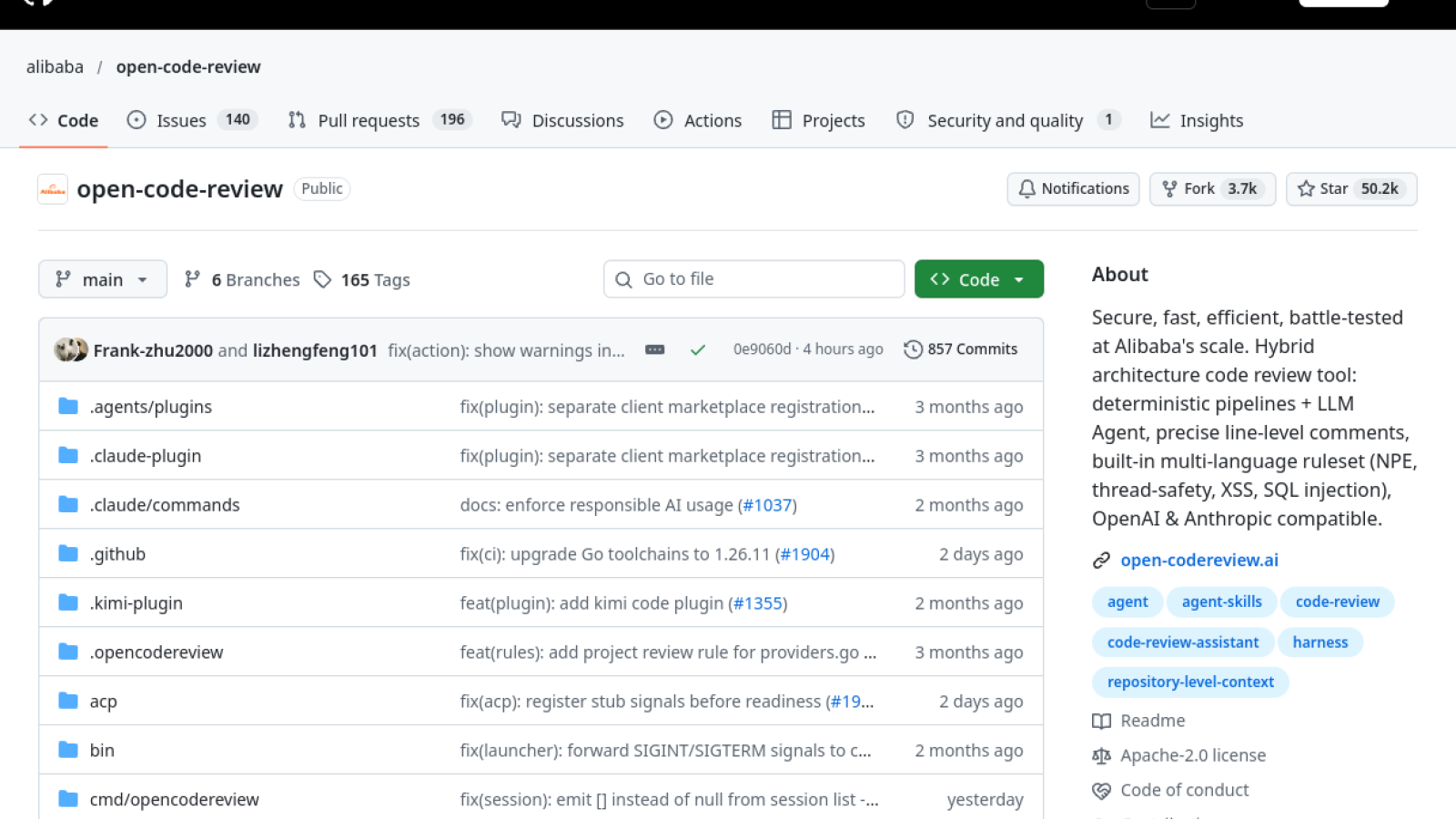
The most-starred repository on GitHub today is not a shiny new app. It is a code reviewer — Alibaba's internal AI code-review assistant, open-sourced under the name Open Code Review, and it has picked up more than 50,000 stars in about six months of public life. The pitch is a specific one, and it is worth taking seriously: instead of handing your diff to a general-purpose coding agent and hoping for the best, Open Code Review splits the job. Deterministic engineering handles the parts that "must not go wrong," and an LLM agent handles the parts that need judgment. Its own benchmark says the split works — higher precision than Claude Code at roughly one-ninth the tokens. The honest version of that claim, including what the benchmark does not prove, is below.
Not just another "ask the LLM to review" tool
Most AI review tools are a prompt wrapped around a diff. Open Code Review's design is the reason it is interesting, and it is the part the README spends the most time explaining. The tool — a CLI called ocr, written mostly in Go — reads your Git diff and produces structured review comments with line-level precision. But before any LLM sees the code, deterministic pipelines do the unglamorous work: precise file selection (which files need review, which to filter out), smart file bundling (related files grouped into one review unit — the README's example is message_en.properties bundled with message_zh.properties — each bundle reviewed by a sub-agent with isolated context), and fine-grained rule matching, where review rules are matched to each file's characteristics via templates rather than prompts. Separate positioning and reflection modules then fix the two classic AI-review failure modes: comments landing on the wrong line, and comments that sound confident but are wrong.
The LLM agent, meanwhile, does what agents are actually good at: reading full file contents, searching the codebase, and inspecting other changed files for context. The built-in ruleset covers multiple languages and the usual suspects — null pointer exceptions, thread-safety issues, cross-site scripting, SQL injection, and more. The project says the tool served tens of thousands of developers and identified millions of defects over two years inside Alibaba before being open-sourced. Those are the project's own figures, not independently verified — but the design is genuinely different from "paste the diff into the chatbot," and that is the point.
There are two ways to run it. In the default mode, Open Code Review calls the LLM you configure. In Delegation Mode, your own coding agent performs the review using its own model and subscription, while Open Code Review handles file selection and rule resolution — so no separate API key is needed at all. Integrations cover Claude Code, Codex, Cursor, Kimi Code, OpenCode, and QCA Forward, plus GitHub Actions, GitLab CI, Gerrit, an MCP server, and a Session Viewer that replays review sessions in the browser.
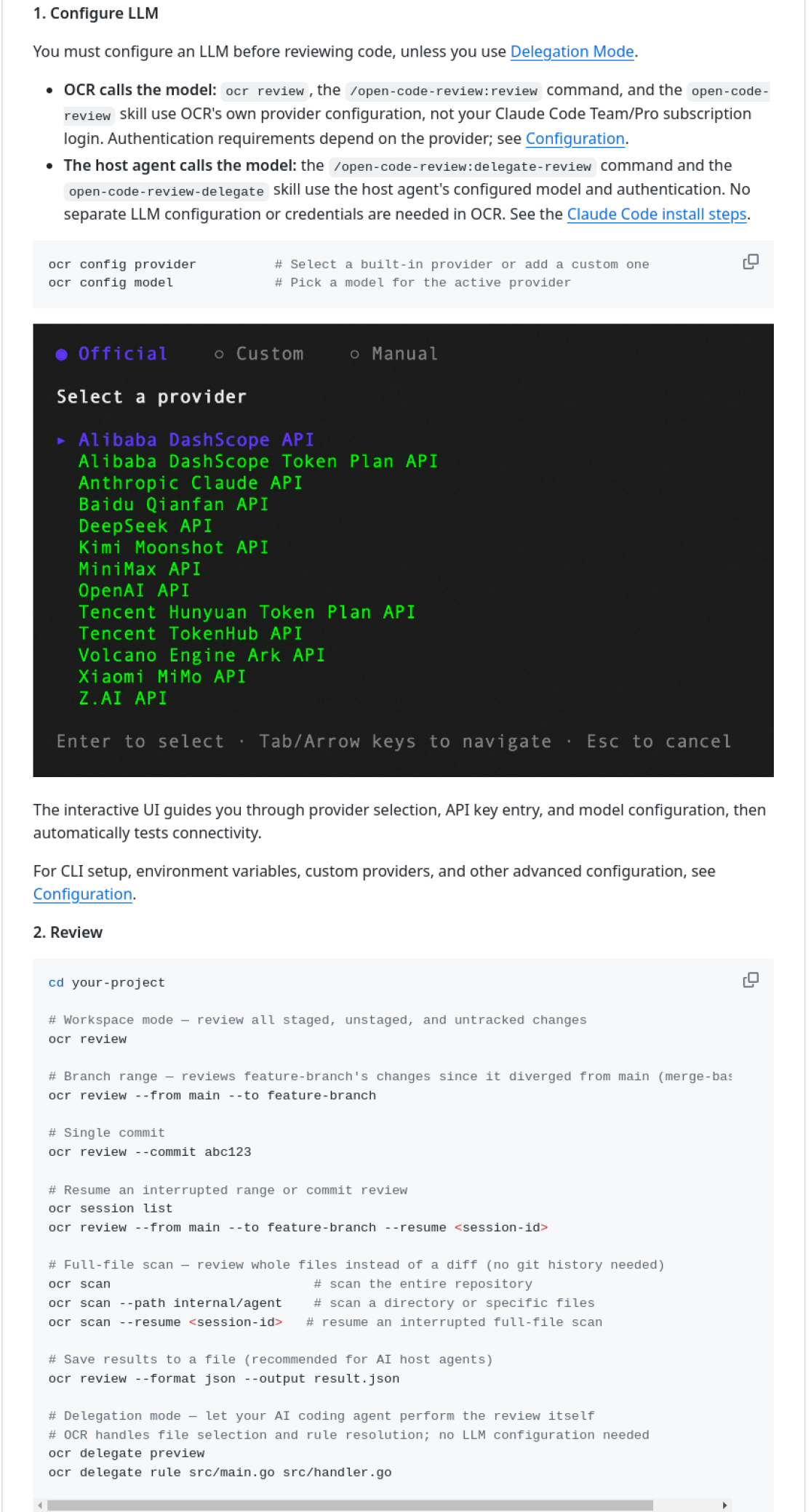
Screenshot: github.com/alibaba/open-code-review — the provider picker and the first commands.
What the numbers actually say
The headline claim lives in the README's benchmark section, and it deserves a careful read. On AACR-Bench — a dataset the project built itself, 50 popular open-source repos, 200 real pull requests, 10 programming languages, 1,505 annotated ground-truth issues cross-validated by more than 80 senior engineers — Open Code Review with Claude-4.6-Opus scored 25.10% F1 and 33.90% precision, against 14.13% F1 and 15.93% precision for the same model running through Claude Code. It did it in 1 minute 23 seconds and about 385,000 tokens, versus 5 minutes 38 seconds and over 2 million tokens for Claude Code. Roughly one-ninth the tokens, nearly double the F1.
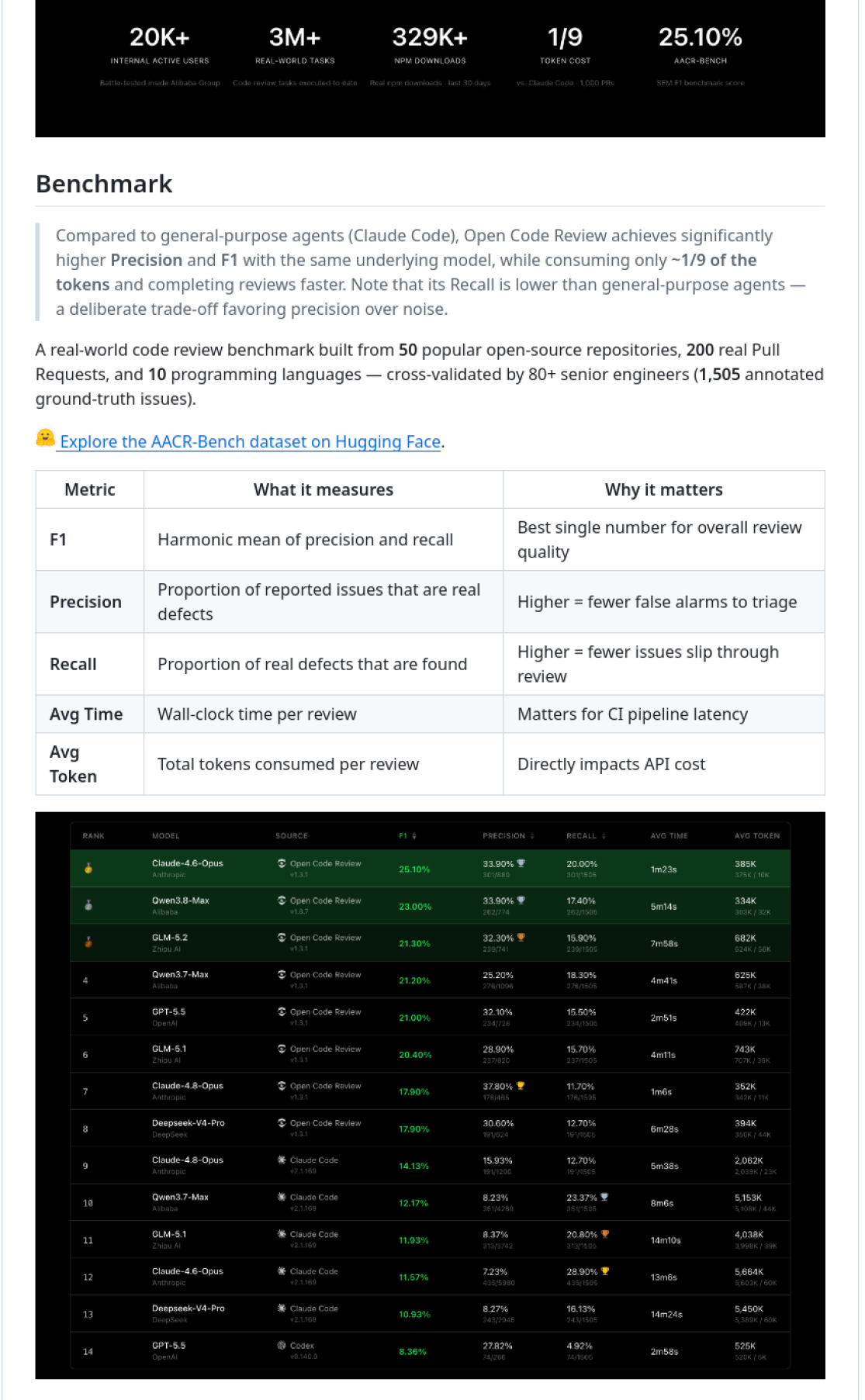
Screenshot: github.com/alibaba/open-code-review — the project's benchmark results.
Now the part the project itself is honest about: recall. Even the best configuration found only about 20% of the annotated real defects. That is a deliberate trade-off — precision over recall, fewer false alarms at the cost of missing most genuine issues — and the README says so openly. A reviewer that cries wolf less often is genuinely useful in a pull request. A reviewer that catches one in five real bugs is not a replacement for human review, and it is not a replacement for a test suite. Read the 25% F1 as "better than the alternatives at this specific job," not as "finds a quarter of all bugs and that's good." It finds a fifth. The other four-fifths are still yours.
The benchmark is also self-reported: Alibaba built the dataset, ran the comparison, and presents it in its own README. No independent replication is cited. Treat "beats Claude Code" as the project's claim, tested on its own home turf, not as an independent finding. Results also vary widely by model — F1 runs from roughly 8% to 25% across the table — so the cheap models score far worse.
Getting started in five minutes
The install is one command, with one prerequisite: Git 2.41 or newer, since the tool relies on Git for diff generation, code search, and repo operations.
npm install -g @alibaba-group/open-code-reviewThen configure a provider — ocr config provider opens an interactive picker — and a model with ocr config model. The built-in provider list is long: Alibaba DashScope, Anthropic Claude, OpenAI, DeepSeek, Kimi Moonshot, MiniMax, Baidu Qianfan, Tencent Hunyuan and TokenHub, Volcano Engine Ark, Xiaomi MiMo, and Z.AI, plus custom providers. Then:
ocr reviewThat reviews your workspace changes. ocr review --from main --to feature-branch reviews a branch range, ocr review --commit abc123 reviews a single commit, and ocr scan reviews entire files or directories with no Git history needed. Results can be exported as JSON for agent handoff, and sessions are resumable. It runs on Windows, macOS, and Linux. The latest release, v1.13.9, landed hours before this article was written — the 147th release in six months, which tells you how fast this project is moving.
What it actually costs
The tool is free — Apache 2.0, npm install, no license fee. The LLM is not free. In default mode you pay your chosen provider's per-token API rates, and a single review can consume around 385,000 tokens even in the efficient mode. That is the real cost, and it scales with the model you choose and the size of the changeset. Delegation Mode avoids a second bill by using your coding agent's own model and subscription. Budget for the API, not the tool — and note that the project's own numbers say a general-purpose agent doing the same review burns over 2 million tokens, so the "cheap" route here is still a five-figure token count per review on a large change.
The honest caveats
A few things to know before you wire this into CI. The project is young in public — created May 18, 2026, about six months of public history however long its internal Alibaba life was. Review quality depends heavily on the model you pick. It reviews code; it does not fix it — output is comments and findings, with no auto-fix claim in the README. And there are 336 open issues at the time of writing: an active project, but check the issue tracker before recommending it for production CI.
None of that changes the core verdict. Open Code Review is the most interesting code-review tool to hit GitHub trending this year because it treats review as an engineering problem first and a prompting problem second — and because it is honest in its own README about what it does not do. If your team is drowning in pull-request noise and you already pay for an LLM API, it is worth an afternoon. If you want a free lunch, or a tool that catches everything, keep looking: the API bill follows, and four out of five real bugs still slip through.
Open Code Review is free and open source under Apache 2.0 at github.com/alibaba/open-code-review. Also today: Microsoft's outage is still ongoing and Google's Gemini smart glasses are open for pre-order from $395. For more AI developer tools, see our coverage of Google Skills, the Cloudflare security audit skill, and Codex Security.