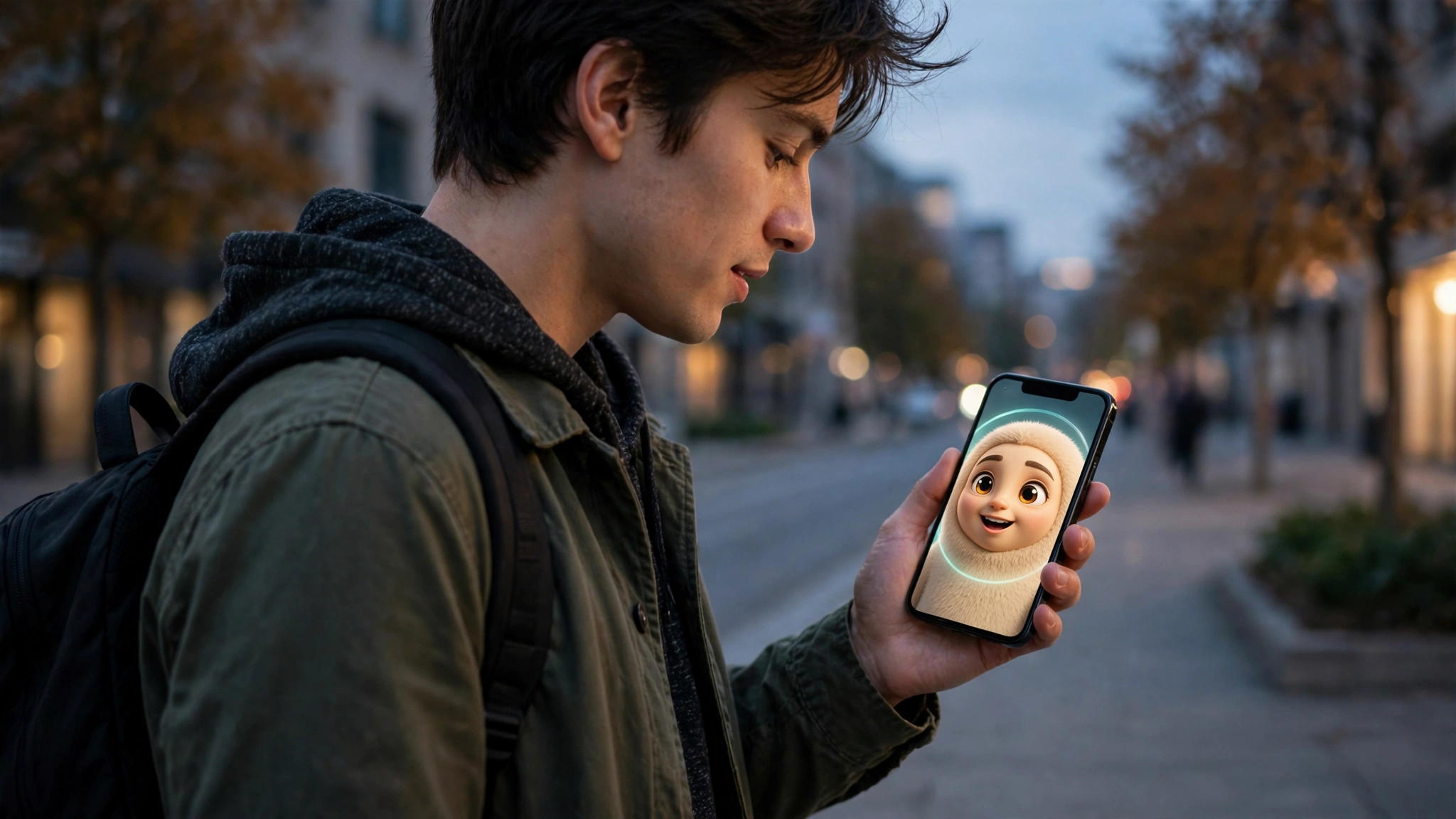
Meta’s personal AI agent just got a voice and a face. On November 5, the company rolled out real-time voice conversations and an expressive animated avatar in the Muse app, so you can talk to Muse the way you’d talk on a phone call — and watch it react while you speak. Tap the phone icon in the top-right corner of a chat, start talking, and Muse answers out loud, immediately, with an avatar whose expressions and gestures track the tone of the conversation. You can interrupt mid-answer. It keeps working on tasks in the background while you talk.
There is one big catch, and it belongs at the top, not in a footnote: this is US-only to start. Muse itself is available in Canada, Japan, Singapore and Mexico — but the voice rollout has no date for any of them. If you’re reading this in Canada, you can’t try it today, and Meta hasn’t said when that changes.
What actually launched
The feature, which Meta calls Muse Voice, was previewed at Meta Connect on September 23 and arrives as two linked systems: Muse Realtime Voice, which produces spoken replies, and Muse Realtime Avatar, which generates the animated face from the same stream of speech tokens. Because both come from one token stream, the voice, lip movement and expression stay in sync — it’s one continuous performance, not a voice clip pasted onto a looping animation.
The avatar is a character you can change. The default is nicknamed Jolly. Meta’s chief AI officer Alexandr Wang demoed his as a fluffy white dog. You can make it look like a person, an animal or something else entirely, and pick from what Meta describes as “hundreds of voices” — no exact count, but the examples given are the energy of a New Yorker or the flair of a pirate. The Verge’s Jay Peters tested it on iOS on launch day and set his avatar to look like Mark Zuckerberg, which he called “quite weird” — a fair warning about where the uncanny valley sits with a face you choose yourself.
Three views are available: voice-only, the avatar sitting beside the conversation, or full-screen face-to-face. The avatar reacts while you’re still talking, so you can tell it’s following along — but it does not see you. There is no camera on your side of the call. Muse hears you and reacts to the conversation, not to your face. That’s a deliberate design choice, and it matters for how much you should read into the “face-to-face” framing: it’s a face that talks to you, not a video call.
It works on the Muse app on mobile, the web at muse.ai, and Mac. There’s no waitlist and no switch to turn on, as far as anyone has documented — update the app and the phone icon is there. Some users had it quietly from October 24, before the November 5 announcement, which explains why reports of availability have been a little uneven. The safest way to put it: it’s rolling out to US users from November 5, not switched on for every US user at the same instant.
What it’s for, in practice
Meta’s pitch is thinking aloud instead of typing. Rehearse an interview while you walk. Brainstorm out loud while cooking. Plan a trip while doing something else with your hands. The Verge’s hands-on found Muse responds quickly over voice, though it occasionally pauses while looking up information — the same rhythm as a text chat, just spoken.
That framing is worth taking seriously, because it separates voice chat from two things people keep confusing it with. It is not Muse’s phone-calling feature: that’s the separate capability, live since September 17, where Muse dials a business on the phone network for you and reports back — you’re not on the call at all. And it is not voice notes or dictation. This is a live conversation with the agent itself, where the agent keeps working on your tasks in the background while you talk.
The comparison that matters most is the one Meta is clearly aiming at: the voice modes in ChatGPT and Gemini, which have had live voice for a while. Muse’s differentiator is the avatar — a persistent, customizable face that reacts — and the agent underneath, which Meta is positioning as something that plans, books and buys through connected apps rather than just answering questions. Whether the avatar is a genuine advantage or a novelty depends entirely on whether you want your AI to have a face. Some people will find it engaging; some will find it, in Peters’ word, weird.
The price question, and the Canada problem
There is no voice-specific price or subscription condition in the November 5 announcement. Voice arrives for US users with no plan requirement mentioned. But Muse itself has tiers, and they’re worth knowing because voice usage presumably draws on the same allowance: a free tier with a weekly usage limit Meta doesn’t publish, Power at $20 a month, and Maximum at $100 a month. One independent tracker argues heavy voice use could burn through the free limit faster, since you’re generating far more tokens by talking than by typing — but Meta has not stated that, so treat it as inference, not fact. Muse is 18+.
The Canada situation is the honest caveat this story needs. Muse reached Canada on September 18, 2026, a little over a week after its September 8 US launch. Voice, though, is US-only with no date for Canada, Japan, Singapore or Mexico. That leaves out three of the four countries where Muse is available. There’s no workaround worth recommending — no settings toggle, no region trick — and anyone suggesting one is guessing. Canadian readers should treat this as a preview of something coming, not a feature to go looking for today.
What’s still coming
Two more surfaces are promised and neither has a date. Voice conversations are “coming soon” to Meta AI Glasses, and to Muse Charm, the small pocket-sized wearable with a tiny screen for the avatar. Press reporting says Charm is supposed to ship before the end of the year, with a December holiday target, but only a handful of prototype units have been built, no price has been announced, and Meta’s own line is “more details later this year.” Rumored prices in the $129–$149 range are single-source leaks — don’t plan around them.
The technical background is worth a paragraph, because it explains why this launch looks the way it does. Meta AI Research describes the avatar as an audio-driven Diffusion Transformer, generating 448×768 portrait video at 25 frames per second, with about 870 milliseconds from the end of your turn to the first byte of synchronized voice-and-video response. The company claims distillation cut generation from 120 guided teacher evaluations per chunk to 2 unguided student evaluations, and that 12 concurrent real-time sessions can run on one GB200. All of that is Meta’s own claim, not an independent benchmark. The research post also carries a warning worth repeating: its examples “do not all reflect avatars available in the Muse app.” The research system can animate portraits, full-body illustrations, animals and everyday objects; the app rollout is narrower than the demo reel.
One more detail from that research post: generated avatar video carries a durable, invisible Meta Video Seal watermark, added without extra real-time latency. In a year when AI-generated faces are everywhere, that’s a small but real piece of provenance.
The honest read
Muse Voice is a genuine step for Meta’s agent — the moment it stops being a chatbot you type at and becomes something you talk to, with a face that talks back. The technology is real, the rollout is real, and the hands-on reports so far are positive on responsiveness. But the launch is narrower than the announcement’s energy suggests: US-only, no date for anyone else, glasses and Charm still “coming soon,” and the most impressive avatar demos are research showcases, not what’s in the app today.
If you’re in the US, it’s worth trying — it’s free to start, it takes one tap, and the voice-only mode sidesteps the uncanny-valley question entirely. If you’re in Canada, the right move is to wait, and to watch for the moment Meta names a date. And if you’re wondering whether an AI assistant needs a face at all, this is the first mainstream test of that question at scale. The answer will be written by how many people keep the avatar on after the first week.
For context on Meta’s AI push, see our Muse Spark Open model release and Anthropic’s Claude Duet agent — and for the other side of Meta’s week, the $25 billion New Mexico fine.
Also today: Xbox Cloud Gaming Phone Controller: Play on TV Now and Google Skills: 186 Free Agent Skills for Google Cloud.