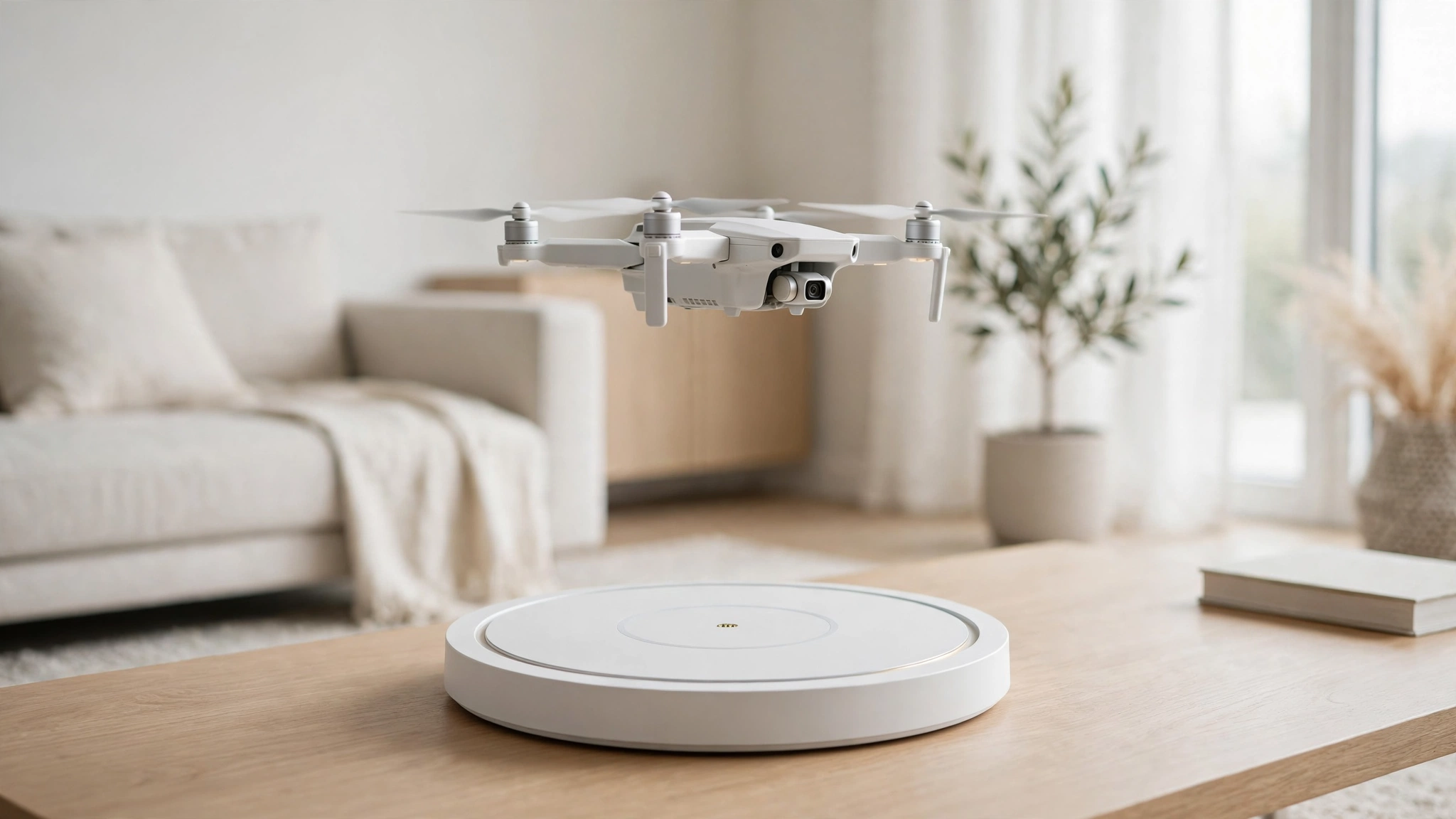
Six years ago, Amazon announced a flying security camera for your living room, charged $249.99 for it, and then never really sold it. On November 10, Amazon’s Ring announced the same idea again — same price, same concept, same promise — and this time it says the drone will actually ship, on January 27, 2027. There’s just one problem: you still can’t buy it. There’s no preorder page, only an email sign-up, and Amazon’s own announcement carries a line that should stop any buyer in their tracks: the device “has not been authorized as required by the rules of the Federal Communications Commission” and “may not be offered for sale or lease, or sold or leased, until authorization is obtained.” January 27 is a target, not a promise.
What the drone actually does
The Ring Drone Cam is the first product in Ring Robotics, a new category Amazon describes as “autonomous, mobile security.” It weighs 165 grams — about as much as a smartphone — and lives in a dock. When it’s docked, its camera is powered down. When it flies, it follows preset or custom routes on a schedule, flies to investigate when a Ring camera, sensor, or alarm triggers, or flies on demand when you tell it to. It can fly between rooms and upstairs, and it works with Alexa Home Map, the new 3D home-mapping feature Amazon announced the same day: tap a room and the drone charts a course there.
The camera is a 2K front unit with a 148-degree field of view that rotates 360 degrees, plus a second 1080p camera underneath and two built-in LED lights for night patrols. Both devices in the Ring Robotics line run AI Pilot, Ring’s system that uses the cameras, specialised vision models, on-device sensors, and cloud processing to map a space, suggest patrol points, and navigate around obstacles. The drone builds its floor plan during setup, when you carry it through your home — and then, mostly, it flies on Wi-Fi and cloud processing, with almost no onboard sensors beyond what’s needed for landing. It lands or returns to the dock when the battery or the Wi-Fi runs low.
And that battery is the number that changes the whole conversation. Ring’s official spec is “up to 8 minutes” of flight per charge, tested with a new, fully charged battery under controlled conditions. Engadget says 8 to 10 minutes; The Verge and Bloomberg say 5 to 8. Take the official 8. Then look at the charging ratio: roughly eight minutes of charging for every one minute of flight, according to Engadget and The Verge. A five-minute patrol needs about forty minutes on the dock. This is not a camera that watches your house all evening. It’s a camera that makes short, scheduled rounds and spends most of its life charging — which, to be fair, is the design. Ring’s pitch is that the drone checks a specific thing at a specific time, or responds to a specific trigger, and then goes home. If you were imagining a drone hovering over your hallway all night, reset that expectation now.
The 2020 original, and the two versions that never shipped
None of this is new, and that’s the most interesting part of the story. The original Ring Always Home Cam was announced on September 24, 2020, at Amazon’s hardware event — same $249.99 price, same concept, same camera-blocked-while-docked privacy design, same deliberately audible hum. It was offered invite-only in 2021 and never reached general sale. It turned up at CES in January 2023, and Ring founder Jamie Siminoff told The Verge in early 2023 that 2024 was the earliest it could ship widely. It didn’t.
Siminoff told The Verge this week that the company has been working on the drone since 2016 and came close to shipping two earlier versions before scrapping them and starting over about a year ago. The breakthrough, he said, was moving most of the processing to the cloud and cutting the onboard sensors — doing it onboard “would probably drive its retail price up past $5,000,” he told Engadget. Same $250 price, six years later, because the drone got dumber and the cloud got smarter. That’s a genuine engineering story, and it explains why the drone depends so heavily on Wi-Fi: there’s almost nothing in the air but a camera and a motor. It also explains why the demo flights journalists saw were about a minute long, in a simple staged living room, with no obstacle or stair navigation tested. Nobody outside Ring has flown this thing properly yet.
Ring’s own fine print adds navigation limits worth knowing: the drone works best in rooms with varied visual detail, and it can be confused by polished marble, wet tile, plain matte walls, frameless glass, and mirrors. It’s indoor-only — software blocks outdoor flight, with Siminoff citing FAA line-of-sight rules — and the dock can’t hang on a wall. Mirrors and windows were the hard problem for years, according to The Verge, which is exactly the sort of thing a house full of glass will test on day one.
The sibling you can actually buy
If the drone feels like a promise, its sibling is a product. The Ring Rover Cam is a wheeled indoor patrol robot for businesses — shops, offices, warehouses — built on Amazon’s Astro home robot, with the same display, two wheels, and a periscope camera. It costs $999.99, preorders are open now, and it ships December 16, 2026, in the US. It records and streams up to 4K video while moving, does a 360-degree scan when it arrives at a patrol point, and its periscope camera rises to about four feet to see over counters and shelving. It has a siren, a light tower, two-way audio, and person-motion detection that keeps working even while docked. Sleep Mode retracts the periscope and turns off the mic with one tap.
The Rover maps up to 5,000 square feet on a single floor — it can’t climb stairs, and it won’t handle curved edges, sunken areas, black glossy floors, or floor transitions above 1.375 inches. Runtime is about 30 minutes of patrol per charge, according to Bloomberg reporting (Ring itself only lists the roughly 45-minute recharge time), so this is also a short-rounds device, just a longer one. The context that makes the $999.99 price interesting is Astro for Business, which launched in November 2023 at $2,350 and was discontinued about a year later. The Rover costs less than half that, and Ring is pitching it explicitly as “not a home robot that also does security, but a purpose-built security robot.” The business pitch, at least, is a real product with a real ship date.
The subscription in the small print
Both devices come with a cost Amazon puts in a footnote: “A compatible Ring Protect plan is required” for scheduled patrols and flights, and for saving and reviewing recorded video. Without a plan, you get the hardware and a live view, not the features that make it a security system. Ring’s published US plans run $4.99 a month for Solo, $9.99 for Multi, and $19.99 for Pro — but no source has confirmed which tier these two devices actually need, or the exact price for them. Several outlets note that this is simply unreported so far. No local storage option has been confirmed for either device, either. Add the plan to the price before you decide whether $249.99 is the real cost, because for the drone’s headline features, it isn’t.
Then there’s the FCC asterisk, which deserves its own paragraph because it’s the difference between a launch and an announcement. Since December 22, 2025, FCC rules have blocked new authorizations for foreign-produced drones and drone components unless they qualify for an exemption — which is very likely why US assembly matters here, and why Siminoff told The Verge the US-assembled drone “does comply with” FCC regulations, with certification “in process.” No source says when authorization will land. 9to5Google only commits to “January” 2027, not the 27th. If the FCC process slips, the ship date slips with it, and there’s nothing a buyer can do about that except wait. The Rover Cam, notably, carries no such caveat.
The privacy question Ring can’t dodge
A camera that maps your whole home and streams 2K video to Amazon’s cloud is a privacy story before it’s a gadget story, and Ring knows it. The company’s pitch is that privacy is the default: the camera is off while docked, there’s an LED indicator when it’s recording, the propellers are deliberately not quiet — “designed to be seen and heard” — and there’s no microphone, speaker, or siren on the drone at all. It can’t listen. It can only look, and only while flying.
The counterweight is Ring’s record. In 2023 the FTC charged Ring after employees watched private video feeds and lax security exposed around 55,000 accounts. Ring’s TAKE encryption, introduced in September 2026, encrypts video in transit and rotates keys every few minutes — but Ring temporarily holds keys for cloud-based AI processing before deleting its copy, which the EFF called an improvement but “still far short of true end-to-end encryption.” The police partnerships that have dogged Ring for years are part of the same picture: a Super Bowl ad for its AI pet-finding tool drew backlash in 2026, and Ring later cancelled an integration with Flock Safety’s automated license-plate readers. None of that means the drone is spying on you. It means the company asking you to trust a flying camera in your home is a company that has had to earn that trust back, and the drone’s own design — camera off in the dock, loud by design, no mic — reads like a company that knows it.
So who is this for? The Rover Cam, for a small business that wants a patrol robot and can live with 30-minute rounds, is a straightforward buy — it’s on preorder, it ships in five weeks, and the price undercuts its predecessor by more than half. The Drone Cam is a different proposition: a $249.99 sign-up for a device that flies eight minutes at a time, needs a subscription for its headline features, needs Wi-Fi and a visually varied room to navigate, and still needs the FCC’s signature before anyone can sell it to you. The idea has been six years in the making and two versions in the bin. The third version might finally be the one. Watch the FCC authorization first — that’s the date that actually matters — and wait for someone outside Ring to fly it through a real house before you put your name on the list.
Also today: November Pixel Drop: Pixel Tag, Gemini & More and shadcn/improve: Free AI Code Audit Skill.