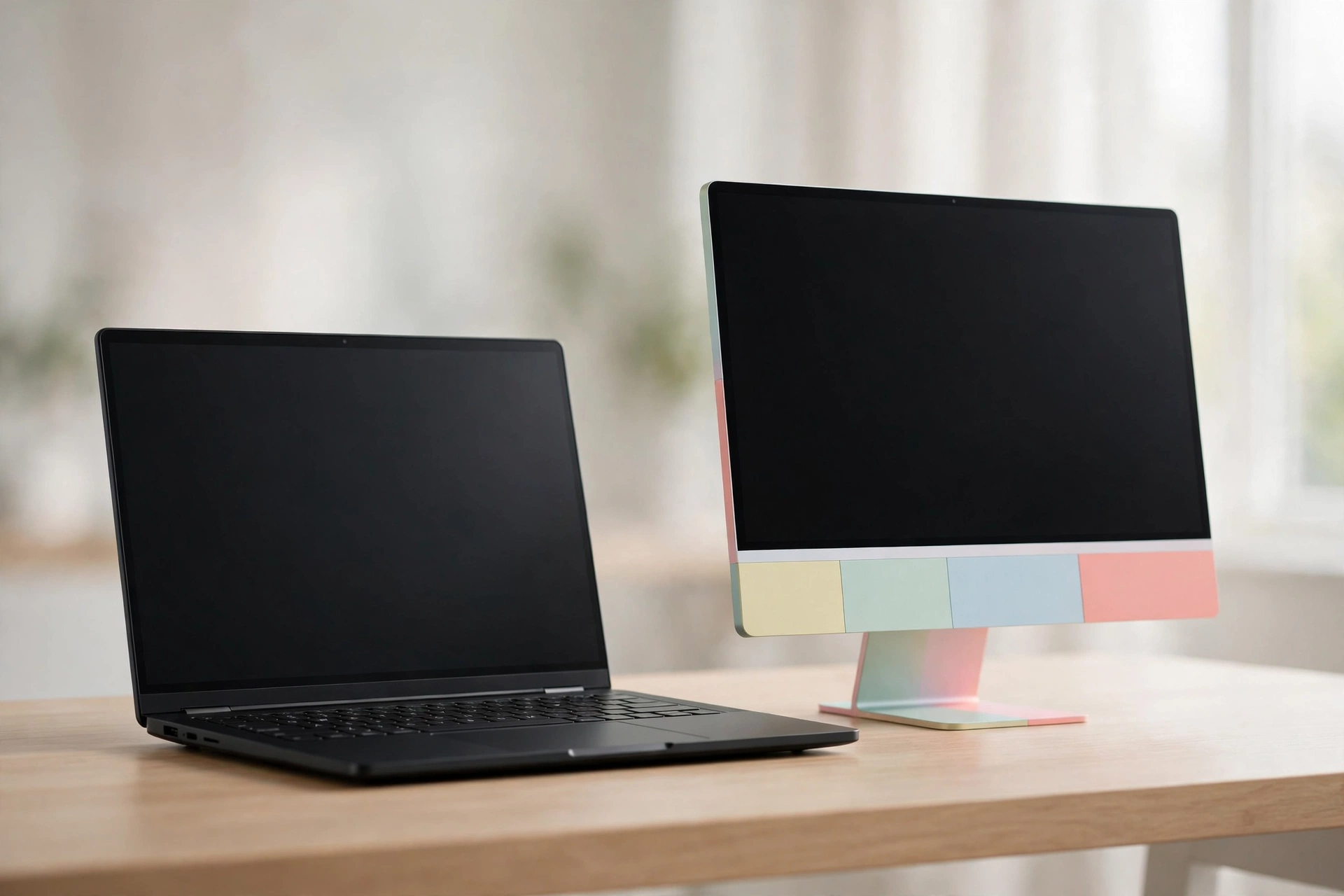
Apple didn’t wait for its own event. A day before the “Pro and Tell” showcase in Los Angeles, the company quietly pushed out the news itself: the entry-level 14-inch MacBook Pro and the 24-inch iMac now run on the M6 chip. Pre-orders open today, October 28, in 35 countries and regions, with both machines arriving November 6. Prices are unchanged from where they landed after June’s increase — $1,999 for the laptop, $1,499 for the iMac.
That’s the headline, and it’s a deliberately boring one. Same designs, same displays, same colors. Everything that changed is inside the chip, and Apple is selling it on one idea above all: running AI on the device instead of in the cloud.
The chip doing the work
The M6 first appeared in the Mac mini back in August, so this isn’t a brand-new silicon debut — it’s the chip spreading across the lineup. In its full configuration, the M6 carries a 12-core CPU and a 12-core GPU, two more cores of each than the base M5, plus a Neural Accelerator baked into every GPU core and a dual 16-core Neural Engine. Memory bandwidth reaches 170GB/s.
Apple’s performance claims, as usual, need a footnote: these are Apple’s own numbers, not independent test results. Against the M5 MacBook Pro, Apple says graphics are up to 30% faster and AI workloads up to 25% faster, with prompt processing in local language models up to 1.3x quicker to the first token. The iMac skipped the M5 generation entirely, so its comparison point is the M4 model — up to 2x faster graphics and up to 5x faster on-device AI, plus SSDs Apple says are up to twice as fast.
The more eye-catching figures compare the new machines against much older ones — up to 13x faster AI than the M1 MacBook Pro, up to 18x faster than the most popular Intel iMac. Those numbers are technically Apple’s, but they’re mostly a reminder of how far the platform has come since 2020, not a reason for anyone with a recent Mac to upgrade.
What you actually get for $1,999
The 14-inch MacBook Pro with M6 is a single-configuration machine in spirit: one chip, space black or silver, 16GB of unified memory standard and up to 32GB. Storage stretches to 4TB if you’re willing to pay for it. The Liquid Retina XDR display carries over — up to 1,600 nits in HDR, with nano-texture glass as an option — along with three Thunderbolt 4 ports, HDMI, an SDXC slot, MagSafe 3, and a headphone jack.
The battery claim is the one that might actually change how people use the machine. Apple rates it at up to 24 hours, which it calls the longest ever in a Mac. As with every battery figure, real-world mileage will depend on what you’re doing — but if even two-thirds of that holds up in mixed use, it’s a meaningful jump for a pro laptop.
Wireless gets a quiet upgrade too: both new machines move to Wi-Fi 7 and Bluetooth 6 via Apple’s N1 chip, which should mean faster, more reliable connections on modern networks.
Education pricing knocks $100 off, to $1,899.
The iMac’s two-tier trick
The iMac story is slightly more complicated, because there are two models hiding under one name. The $1,499 version uses a cut-down M6 — 10 CPU cores and 10 GPU cores — with two Thunderbolt 4 ports, support for a single external 6K display, and configurations topping out at 24GB of memory and 1TB of storage. The $1,699 version gets the full 12-core chip, four Thunderbolt 4 ports, two external 6K displays, and options up to 32GB and 2TB.
Both start with 16GB of memory and a 256GB SSD, so the extra $200 buys processing power and connectivity, not storage. Anyone with a serious photo or video library should budget for a bigger SSD or external storage either way — 256GB fills up fast in 2026.
Everything else about the iMac is familiar: the same strikingly thin enclosure, the same 24-inch 4.5K Retina display (23.5 inches on the diagonal, 4480×2520, 500 nits), the same seven colors — blue, green, pink, yellow, purple, orange, silver — plus the 12MP Center Stage camera and six-speaker system. The higher-tier model also adds a Magic Keyboard with Touch ID in the box, and 2.5 Gigabit Ethernet is available as a configuration option.
The awkward timing
Here’s the part Apple didn’t say out loud: these machines arrive the day of an event widely expected to unveil the first touchscreen MacBook Pro. Bloomberg’s reporting has pointed to redesigned 14- and 16-inch MacBook Pros with OLED displays and touchscreens at today’s Los Angeles event, and our Apple October 28 event preview laid out what to expect.
That puts the M6 MacBook Pro in an odd spot. It’s the safe, known-quantity buy — same design Apple has refined for years, a chip generation newer, prices held flat. The touchscreen Pro, if it appears today, will be the exciting one, and almost certainly the more expensive one. Buyers who want the proven machine can order the M6 today; buyers who want the future should at least wait until this afternoon’s announcements before deciding.
It’s also worth noting what this launch is not. Neither machine has a touchscreen, a redesign, or a new display. If you were holding out for a new look, this isn’t it.
Who should actually buy one
The upgrade math splits cleanly by what you’re coming from. If you’re on an M1 Mac, or anything Intel, the jump is enormous — several generations of CPU, GPU, and AI performance in one move, plus Wi-Fi 7 and a modern display. If you’re on an M4 iMac, the decision is closer: the speed gains are real, particularly for on-device AI work, but you’re buying the same design you already own. M5 MacBook Pro owners can comfortably skip this one; a 25–30% Apple-claimed uplift is not a reason to replace a machine that’s barely a year old.
There’s one more wrinkle worth knowing before you order. The prices held today already include increases Apple made in June 2026 — the M5 MacBook Pro originally launched at $1,599 and the M4 iMac at $1,299. “Prices unchanged” is true relative to last month, less comforting relative to last year. Memory prices are also climbing across the industry, which may be part of why Apple is holding the line here rather than cutting.
For everyone else, the timing is genuinely convenient: pre-orders today, machines in hand November 6, and a full picture of Apple’s Mac lineup by tonight once the event wraps. If you’re buying a Mac this fall, wait one more day — not because the M6 machines are bad, but because you’ll finally know everything they’re competing against, including Apple’s own next announcement.
Related reading: Apple’s other big October launch, the iPad mini with A20 Pro, and yesterday’s other Apple announcement, the Apple Creator Studio AI update.