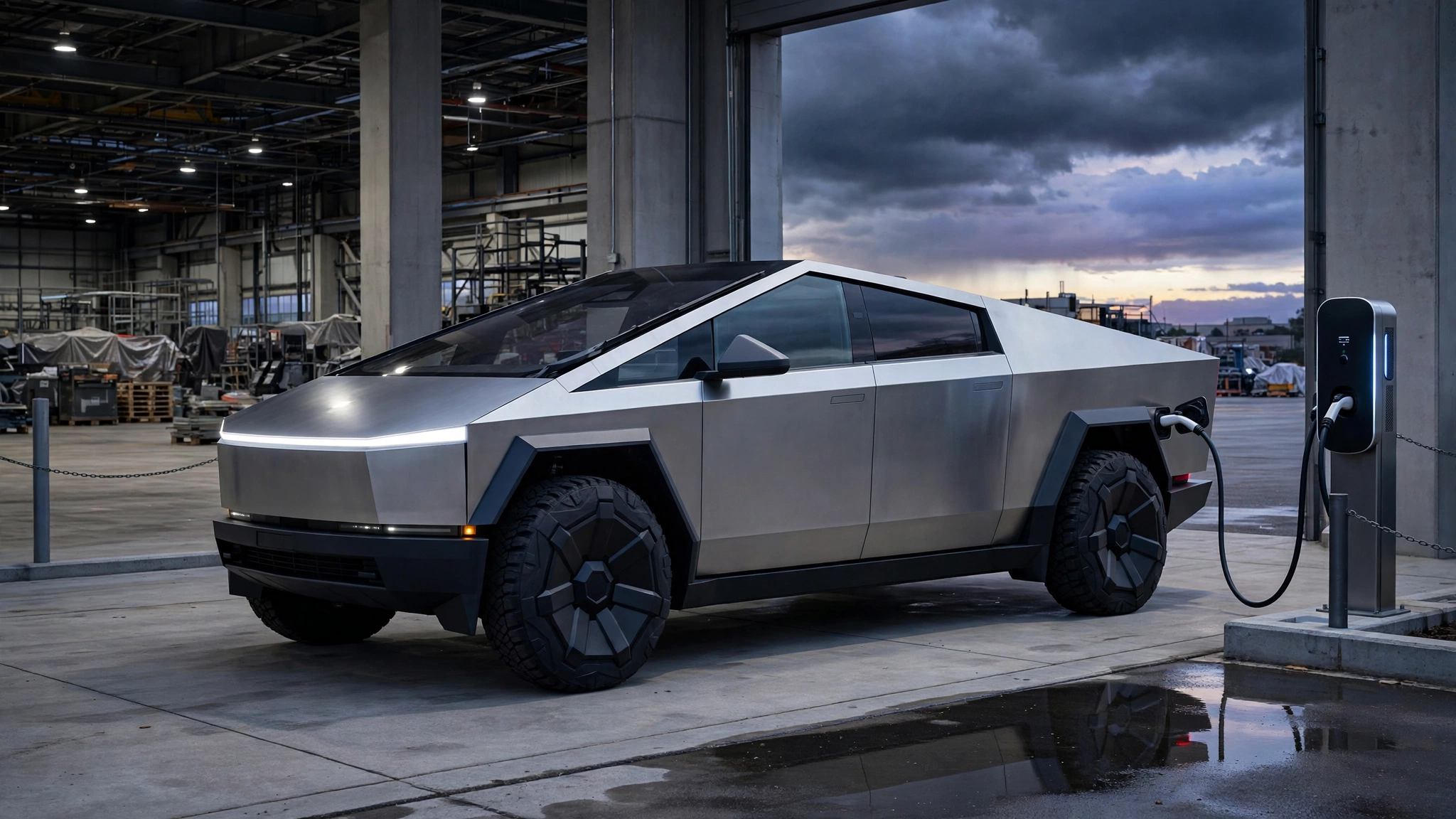
The announcement came in one post, and it was not the word anyone expected
Elon Musk announced on Friday, November 6, 2026, that Tesla will wind down production of the Cybertruck at Gigafactory Texas “around the middle of next year to make room for increased Cybercab production.” No press release. No earnings call. No SEC filing. One post on X, and the most polarizing truck in America has an end date.
That wording matters. Musk said “winding down,” not “discontinued.” The headlines calling the Cybertruck dead are reading between the lines — reasonably, but they are reading between the lines. Production at the only factory equipped to build the truck’s specialized components is ending around mid-2027, and nothing in Tesla’s announcement suggests it will move elsewhere. The Cybertruck’s lead engineer, Wes Morrill, posted the same day that the truck “was an incredible technology development platform and lives on through Cybercab.” The official Cybertruck account posted a farewell-style video of the truck driving into the sunset. Treat this as the end of the model. Just don’t quote Tesla as saying “discontinued,” because it didn’t.
What actually changes, and when
Nothing changes today for a buyer walking into a Tesla store. The Cybertruck is still orderable on tesla.com, and production continues until roughly mid-2027. What changed on Friday is the truck’s future: a production run of about three and a half years, from first deliveries in November 2023 to a wind-down in mid-2027.
Two things did change immediately, though, and they point in opposite directions. Tesla stopped taking orders for the entry-level Dual-Motor AWD the same day as the announcement, and raised prices on the two trims that remain: Premium AWD now lists at $92,490 and Cyberbeast at $102,490, according to InsideEVs, up from $89,990 and $99,990. (Electrek, working from an August price list, put the Premium jump at $7,500 — the size of the rise depends on which baseline you use, but the direction is not in dispute.) The Dual-Motor AWD is still listed on Tesla’s site at $82,490, but it cannot be ordered. A truck being killed off, and getting more expensive on the way out, is an odd combination — unless you read it as Tesla harvesting the last of the demand from buyers who want one precisely because there won’t be more.
The numbers behind the decision
Tesla does not report Cybertruck deliveries separately — it buries the truck in an “Other Models” bucket that totaled just 8,295 vehicles in the third quarter of 2026, against 478,237 Model 3 and Model Y deliveries. Every Cybertruck sales figure you will see is a third-party estimate, and they all point the same way.
Musk’s original forecast was 250,000 Cybertrucks a year. Kelley Blue Book estimates put US sales at 38,965 in 2024, falling to 20,237 in 2025, and 11,586 in the first nine months of 2026 — down 48 percent, then down another 28 percent year over year. The third quarter of 2026 alone was just 4,323 trucks, per Cox Automotive. Total sales across the truck’s life land somewhere around 70,000, with estimates ranging from roughly 63,000 to just under 73,000 depending on the source. The line was built for a quarter of a million trucks a year; it is running at roughly a tenth of that pace.
The truck also accumulated 11 recalls since late 2023, was never sold in Europe — pedestrian-impact rules make approval effectively impossible — and never came in right-hand drive. In October, Tesla told reservation holders in Australia and New Zealand that plans to produce the Cybertruck there had been “discontinued,” cancelling reservations with full deposit refunds and a year of free supervised Full Self-Driving for anyone who ordered a Model 3 or Y instead. At the time, some social posts wrongly claimed that meant the truck was cancelled worldwide. That was wrong then. The global wind-down is only now confirmed.
The reason Tesla gave, and the one that doesn’t quite add up
Musk’s stated reason is floor space: Gigafactory Texas needs room for Cybercab production. The Cybercab is the two-seat robotaxi with no steering wheel and no pedals; paid rides began in Austin in September 2026, and roughly 570 of the 1,200-plus robotaxis operating in Texas are Cybercabs, according to Texas DMV data cited by Reuters. The US safety regulator opened an audit in September into how Tesla self-certified the vehicle.
There is reason to be skeptical of the floor-space explanation, and Electrek has said so plainly: Gigafactory Texas has more than 10 million square feet, and the Cybertruck line runs at roughly a quarter of its installed capacity. Space was not the constraint. The pattern is the tell. In January 2026 Tesla announced the end of the Model S and Model X on an earnings call, with production ending that April — framed the same way, as freeing Fremont for Optimus robots. The Cybertruck is the third Tesla passenger vehicle killed in 2026 to fund the autonomy and robotics pivot. The company is not making room so much as it is choosing what it wants to be: a robot company that happens to sell two cars.
What this means if you own one, or want one
Here is the part Tesla has not addressed at all. As of November 7, the company has said nothing about outstanding orders, how long remaining inventory will be sold, warranty changes, or parts and service support timelines. Musk replied to a user on X that “the Cybertruck fleet will be around for a long time.” That is reassurance on social media, not a support commitment. Do not buy one of the last trucks assuming a decade of parts availability, because nobody at Tesla has promised it.
Who should buy one of the last ones? Collectors, and fans who want the truck exactly as it is — the stainless steel, the angles, the statement — and are comfortable owning a vehicle whose manufacturer has moved on. Who should walk away? Anyone who needs a work truck with long-term support certainty, anyone counting on the sub-$70,000 price point — that truck no longer exists — and anyone who wants a vehicle whose maker is still invested in improving it.
One counterintuitive data point: used Cybertruck prices are actually up, averaging $90,949 in listings tracked by Visor on November 7, up 3 percent month over month and 7.7 percent since June. It is far too early to call that a discontinuation premium — the announcement was yesterday, and the climb started before it. The historical parallel is mixed: used Model S prices rose 13.1 percent and Model X 17.5 percent in the year those cars were discontinued, but that climb also started before the announcement. Demand matters more than the factory stopping.
The bigger bet
After the Cybertruck ends, Tesla’s human-driven lineup is effectively the Model 3 and the Model Y, with the Roadster promised for 2028 production. Everything else the company is building — Cybercab, Optimus — is a bet that the future of the business is machines that drive and work by themselves. The Cybertruck was supposed to be the bridge between the old Tesla and the new one: a truck that proved the company could still make a vehicle people argued about. It sold about 70,000 units, generated eleven recalls, and will be remembered as the most talked-about vehicle Tesla ever built and one of the least-bought. Whether the Cybercab justifies the trade is a question the next two years will answer, one robotaxi at a time.
Also today: Steam free games November 2026 — Payday 3 and Age of Wonders 4 free this weekend and Cloudflare’s security audit skill turns your coding agent into a security auditor. For more on Tesla’s AI pivot, see our NVIDIA DGX Spark 64GB coverage.