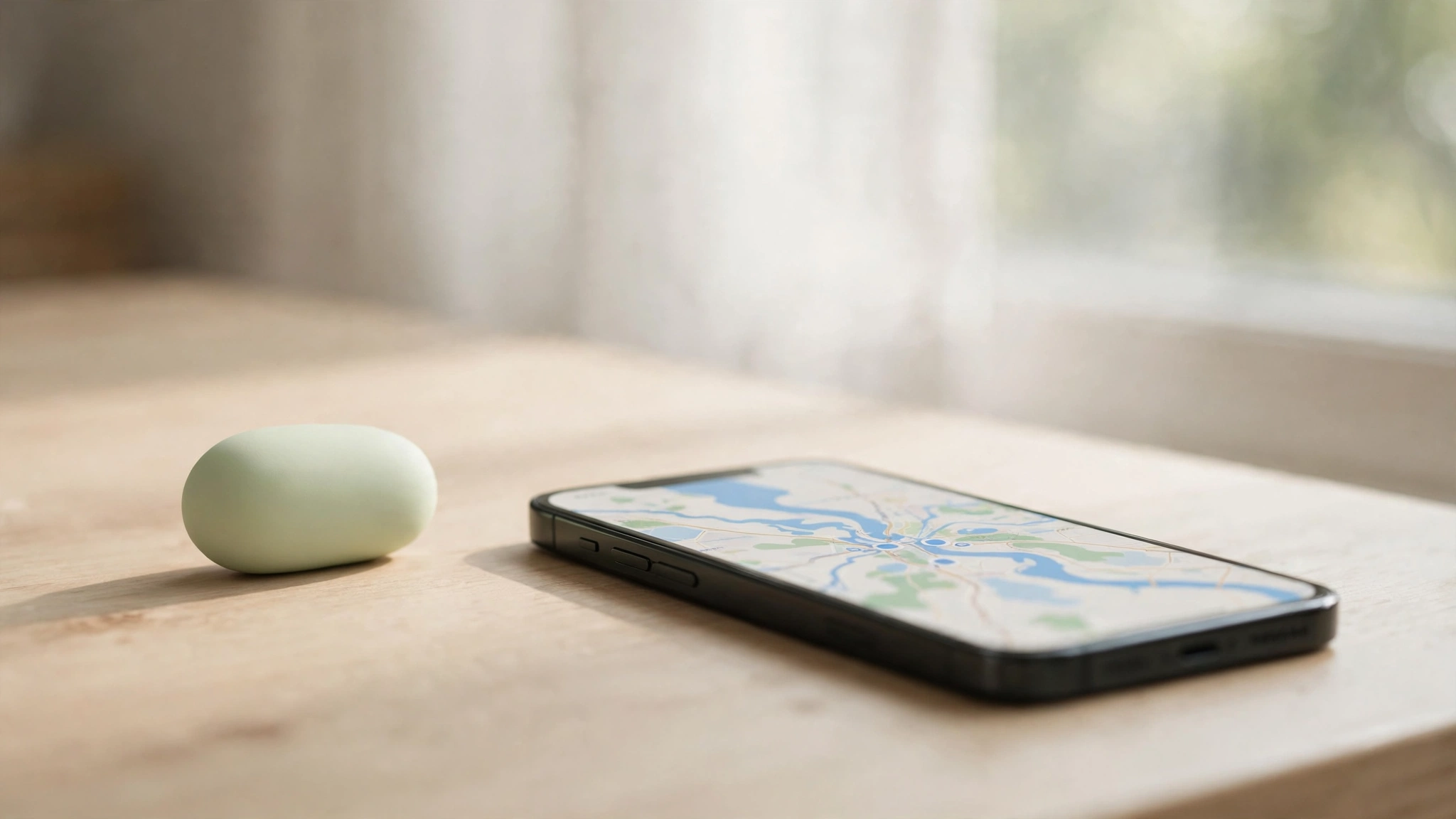
Google picked an odd week to drop its biggest Pixel update of the year. The November Pixel Drop landed on November 10, bundled with Android 17 QPR2 a full month earlier than that update normally arrives, and it does two things at once: it puts a $29.99 tracker on sale today, and it hands last year’s Pixel 10 the AI features that were supposed to be the Pixel 11’s selling point. If you own a Pixel, the next few weeks are worth paying attention to. If you don’t, the Pixel Tag alone is the most interesting thing Google has shipped in a while — with a few catches worth knowing before you buy four of them.
The Pixel Tag goes on sale today, and the fine print matters
The headline purchase is the Pixel Tag, Google’s first first-party item tracker. It’s a slim pebble, 28 × 46.1 × 5.4 mm and 11.8 grams, built to slip into a wallet or onto a keyring, and it goes on sale today, November 11, for $29.99 — or $99.99 for a four-pack. That price is no accident: it matches the Apple AirTag 2 and the Moto Tag 2 almost exactly. Google is not undercutting anyone here. It’s joining the fight at the same price and betting its network wins it.
The network is the Find Hub network, the crowdsourced web of more than a billion Android devices that Google says can locate your tag, with location data end-to-end encrypted. The tag itself has no cellular connection and no GPS, so it isn’t a live tracker in the way a phone is — it reports its position when another Android device passes nearby. Precision finding comes from ultra-wideband, which gives on-screen direction and distance, plus Bluetooth Channel Sounding for distance guidance on phones running Android 16 with Bluetooth 6.0 or later. That last detail is where the fine print starts biting: UWB precision finding needs a UWB-capable phone, and even the base Pixel 10 doesn’t have UWB. Buy the tag, pair it with the wrong phone, and you get Bluetooth proximity, not the arrow-on-screen experience Google shows in its demos.
The rest of the spec sheet reads well. A user-replaceable CR2032 coin cell rated by Google to last “over a year” — a vendor claim, tested by Google on preproduction units, not an independent test. IP67 dust and water resistance. A built-in speaker so you can ring the tag from your phone, and a button on the tag that rings your misplaced phone even when it’s on silent. Left-behind alerts and sharing with up to 10 people, both handled natively in the Find Hub app with no second app to install. One colour: Fog, a pale green that matches the Pixel 11 Pro.
Two things Google hasn’t published: how loud the speaker is (no decibel figure anywhere, and comparison tables from Android Police list it as unknown), and how far Bluetooth or UWB precision finding actually reaches. There is also no iPhone support — this is an Android-only tracker, full stop, and it won’t work with Apple’s Find My network. If your household is split across iPhone and Android, that matters more than any spec. And one date correction worth making, because several outlets got it wrong yesterday: some headlines on November 10 said the tag was “now available.” It wasn’t. 9to5Google explicitly corrected that — the Google Store wasn’t taking orders on the 10th. Google’s own post says November 11, and November 11 is the date.
Gemini Intelligence comes to the Pixel 10 — mostly
The bigger software story is Gemini Intelligence arriving on the Pixel 10, Pixel 10 Pro, Pixel 10 Pro XL, and Pixel 10 Pro Fold. These are the features that debuted on the Pixel 11, and Google is now backporting them to phones that are barely a year old. The headliner is Rambler, the Gboard voice-typing upgrade that strips out filler words and formats your spoken rambling into clean, polished text. Unlike most of the AI features in this drop, Rambler works in all regions and languages on the Pixel 10 family.
Then there’s the agentic stuff: Gemini can now handle multi-step tasks — groceries, rides, takeout, marketplace transactions, reservations — through allowlisted apps, and that automation expands to Japan, the UK, and India, after starting in the US and South Korea. Canada is not included. Gemini can also make calls on your behalf in the US, in English only, using your own number — restaurant reservations, putting items on hold, checking store inventory — with a live transcript and the ability to take over at any time. Proactive suggestions round it out: one-tap ETA sharing when someone asks when you’ll arrive, dinner-spot suggestions when you’re deciding where to eat.
And then there’s the snub. The Pixel 10a gets none of it. Google’s own device lists exclude the 10a from Gemini Intelligence, and Google has given no reason. The 10a only launched in the US in March 2026 — it’s under eight months old — and it’s the cheapest phone in the line, which makes the exclusion sting for exactly the buyers who could least afford to upgrade. If you’re shopping for a Pixel and the AI features matter to you, the 10a is now a noticeably worse deal than it was last week, through no fault of its own.
Gemini Intelligence is also reaching beyond Pixel for the first time in this wave. The Motorola Signature 27 — Motorola’s $1,599 flagship, with US pre-orders opening November 19 — will be the first Motorola device with Gemini Intelligence, including Rambler, Create My Widget, and Gboard Sign-to-Text. Motorola Signature 27 Worth a small correction to the hype: Motorola is the first major expansion beyond Pixel in this wave, not literally the first non-Pixel device ever, since some Samsung Galaxy phones already have support. Still, it’s the clearest sign yet that Google wants Gemini Intelligence to be an Android feature, not a Pixel exclusive.
Create My Widget, a smarter Calculator, and the rest
Create My Widget is the most fun-sounding feature in the drop, and the most limited. Describe a widget in plain language — a monthly spending tracker, a game-day widget, a trip countdown that pulls flight and reservation details from Gmail and Calendar — and Gemini builds it. It’s rolling out now to the Pixel 10 and Pixel 11 series, in select regions and languages, and it’s English-only for now, for users 18 and over, in Australia, Canada, India, the US, and the UK. It’s coming soon to the Pixel Watch 4 and 5. It was first announced at Google I/O in May, and a Play Store listing appeared in September, so this is a long-promised feature finally arriving rather than a surprise.
The Pixel Watch gets its own share. Step-by-step workouts are rolling out now to the Pixel Watch 3 and newer, with per-exercise guidance, rep and weight logging, and live metrics on the watch or phone. Phone-to-Watch Unlock — your watch auto-unlocks when your unlocked Pixel phone is nearby — is coming in the next few weeks, not live yet. Notification summaries arrive with Wear OS 7.1, for the Pixel Watch 3 and newer paired with a Pixel 9 or 10 running Android 16.1 or later.
The long tail of the drop is the usual mix of small, genuinely useful things: Pixel Solver, which brings generative-AI maths into the Calculator app on the Pixel 11; unit conversion in Calculator for the Pixel 6a and newer, with real-time exchange rates; Pixel Search, natural-language search across photos, emails, messages, calendar, and settings; custom icons with ten new styles, now upgraded to the Nano Banana model; HiLight on the Pixel 11 Pro, Pro XL, and Pro Fold, where the rear light glows for messages from favourite contacts when the phone is face down. One wrinkle to note: Google’s own blog says Pixel Search is for “Pixel 6 and newer” in the body and “Pixel 6a and newer” in the fine print. The support post says 6a and newer, so that’s the figure to trust — and the Pixel 6 and 6 Pro are out of this drop entirely, their five-year update window having expired in October.
Google Fi is switching networks again, and it won’t name them
The quietest big change in the drop isn’t on a Pixel at all. Google Fi is bringing back multi-network switching — the feature that made Project Fi famous before Fi went T-Mobile-only in 2023 — under the name “super network.” From November 10, Fi automatically switches between two US 5G networks and millions of secure Wi-Fi networks, using MEP eSIM technology that lets one eSIM chip hold two carrier profiles at once. The Fi app gets a “Your super network” card showing which network is primary and which is secondary. There’s no manual switching at launch; it switches on smart thresholds when Google says it would “meaningfully improve performance.” It costs nothing extra on Unlimited Premium and Flexible plans, and it’s rolling out first to the Pixel 9 and newer with Fi active on eSIM. Wider device availability comes in 2027.
Here’s the catch: Google has not named either carrier. Not one. Engadget and The Verge both guess one is probably T-Mobile, Fi’s long-time partner, and Fi’s senior product manager declined to name the second when asked. Google describes them only as “two of America’s best/fastest 5G networks,” citing Ookla and RootMetrics figures from the first half of 2026. Any article naming the pair is speculating. If you’re a Fi subscriber, the practical question is whether the switching actually improves your coverage — and nobody outside Google can answer that until the rollout has been running for a while. Existing Pixel owners switching to select Fi unlimited plans get 50% off for 12 months, an offer that ends December 1.
Who gets the update, and how to check
The drop ships with Android 17 QPR2 to the Pixel 6a and newer, plus the Pixel Tablet and the Pixel Fold family — 23 devices in total. It started rolling out on November 10 and continues “over the next several weeks” in phases, by device and carrier, so don’t panic if your phone doesn’t have it yet. Check in Settings, then System, then System update. The update also carries 166 Pixel security fixes and 33 functional fixes, with the November 5, 2026 patch level — the security side alone is reason to install it when it arrives.
The honest summary of this drop is that it’s two stories wearing one name. The Pixel Tag is a real product you can buy today, at a fair price, with a network advantage and a few sharp edges — no iPhone support, precision finding that depends on your phone, and a battery claim nobody has independently tested. The software side is the more generous story: Google is giving last year’s phones this year’s AI, which is exactly the kind of thing that makes people keep a phone for another year. Except the Pixel 10a, which gets nothing, and nobody at Google has explained why. That’s the part worth watching — because if the cheapest Pixel is already being left behind eight months in, it says something about how long “Pixel” support really lasts.
Also today: Ring Drone Cam: $250 Flying Camera Ships Jan 27 and shadcn/improve: Free AI Code Audit Skill.