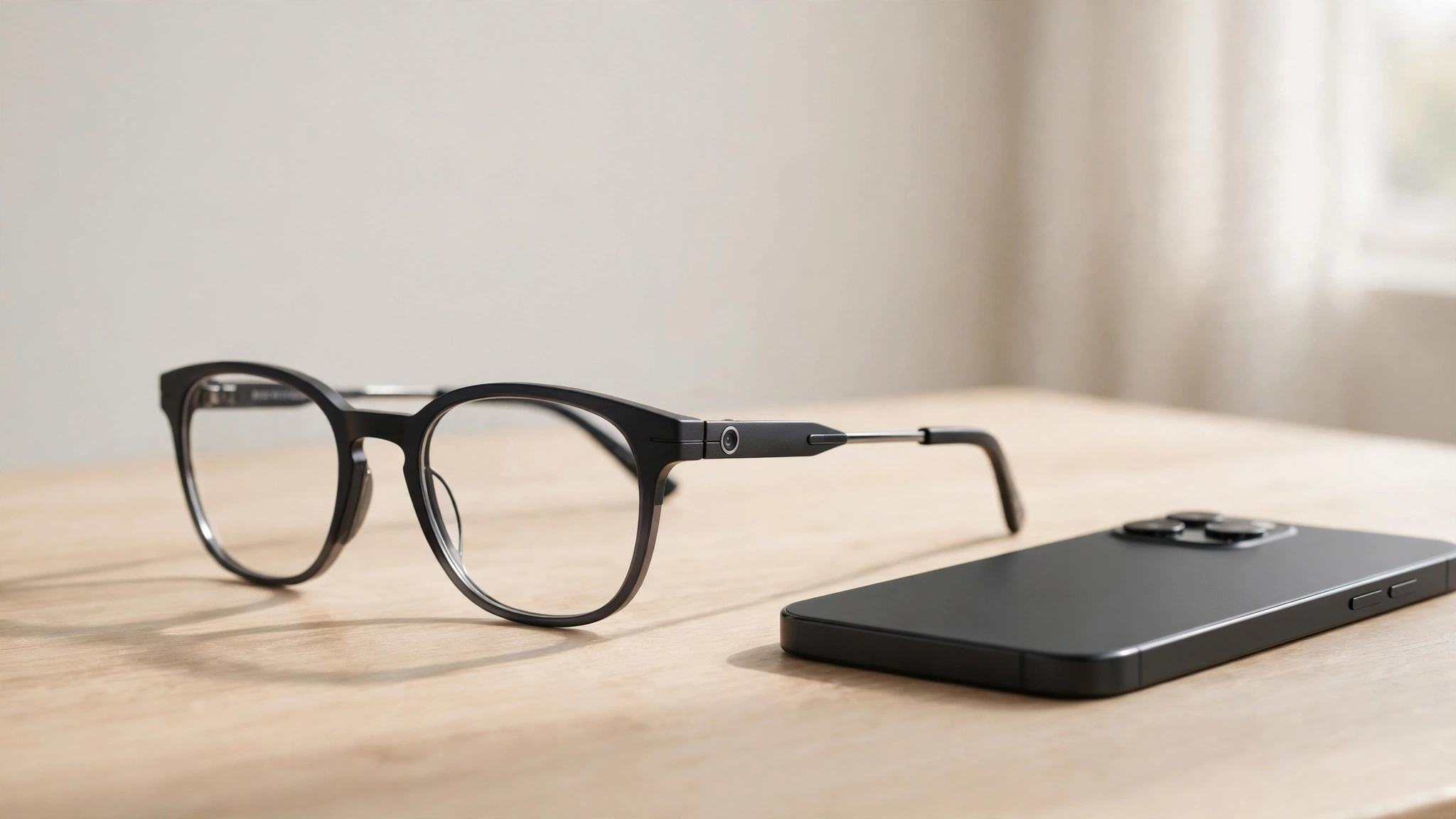
Google's first smart glasses are finally something you can buy — or at least pre-order. Pre-orders opened on November 12 for Google's Intelligent Eyewear, Gemini-powered glasses built with Samsung and styled by Warby Parker and Gentle Monster, starting at $395. They go on sale December 10 in the United States and South Korea. After years of Google Glass false starts and a May demo at Google I/O, this is the real thing: ordinary-looking frames with a camera, open-ear speakers, and Gemini living in your ear.
The headline price undercuts the direct rival by $54 — Ray-Ban Meta Gen 3 launched in September at $449. But the price tag is only the first thing to check. The phone in your pocket, the account on it, and the privacy fine print all decide whether these glasses are actually for you.
What you actually get for $395
Two collections, identical hardware. Warby Parker offers three styles — Alden, Reid, and Wren — in optical or sun versions across Pine, Saddle, and Jet Black, 14 variations from $395. Gentle Monster offers six designs in 16 variations, $449 to $489. Thirty designs in total, and the $54 gap buys a frame, not features.
The spec sheet is the same whichever brand you pick: about 41 grams — Google calls them the lightest smart glasses on the market, a maker claim with no independent test yet — a 12-megapixel ultra-wide camera with HDR and image stabilization, video up to 3K at 30 frames per second with clips capped at 90 seconds, and roughly nine hours of battery per charge. The charging case refills the frames up to seven times, for up to 72 hours total. Inside is Qualcomm's Snapdragon AR1 Gen 1 chip with 2 GB of RAM and 64 GB of storage, running Android XR, with open-ear speakers, four microphones, Wi-Fi 6E, Bluetooth 5.4, and IPX4 splash resistance.
One thing they do not have: a display. These are audio-only glasses. You ask Gemini things out loud, and it answers in your ear. Google confirmed a display version is still in development — it was previewed at I/O in May — but there is no launch window, and it will not ship this year. If a screen in your lens is the point, Meta's Ray-Ban Display at $799 is currently the only display glasses on sale, and Google has no answer to it yet.
Prescription wearers should note the one price Google has not confirmed: prescription lens add-ons. Both brands offer prescription options, but no source could verify the add-on prices from either brand's pricing pages. Confirm the final total at checkout before ordering — the $395 is a floor, not a total.
The phone in your pocket decides
This is the part that will quietly disqualify a lot of buyers. The glasses pair with Pixel 7 series and later phones on the September 2026 Android 17 update, Galaxy S, S FE, Z Fold and Z Flip phones on One UI 9.0 or higher, and iPhones — but Google's own pages disagree on the iPhone floor. The launch post says iPhone 13 Pro and above; the FAQ says iPhone 13 and later with 6 GB of RAM on iOS 26.6 or later. Safe reading: iPhone 13 Pro or newer. Standard iPhone 13 and 13 mini owners should confirm before pre-ordering. Other Android flagships — Honor, Xiaomi, Oppo — are not supported at all.
You also need a Google account from the United States or South Korea, and you must be 18 or older, with age verification required to activate the glasses. Warby Parker sells only in the US; Gentle Monster sells in the US and South Korea. Google has announced no other countries and no dates for them.
And some features are Android-only at launch: Guided Vision, Aira Explorer, and Audible. Uber ride status is also "arriving on iPhones later." If you are an iPhone owner buying these glasses for the accessibility features, wait.
What Gemini does on your face
Say "Hey Gemini" — a new hotword, though "Hey Google" still works — or tap the frame, and Gemini Live answers in a conversational mode customized for glasses, with shorter, lower-latency responses. Look at something and ask about it: identify objects, get a book recommendation from a shelf, check your calendar against an event poster, add items to a grocery list. Turn-by-turn Google Maps directions come through in-ear. Real-time speech translation covers 70-plus languages with automatic detection, and you can trigger a dedicated Translate mode with a two-finger tap on the arm.
There are limits the demos exposed. Translation works one-way in conversation: it translates the other person to you, but it will not translate your own voice back. And Gemini needs explicit prompts — in one demo, a bare "what is this thing?" failed where "Hey Gemini, look at this thing and tell me what it is" worked. Guided Vision, the conversational audio-description feature for blind and low-vision users, comes with Google's own footnote: it "can make mistakes" and is not a mobility aid, not for navigation, obstacle detection, or safety-critical tasks.
The controls are physical where they should be: a touchpad on the right stem, a capture button on top (short press for a photo, long press for video), and a physical off switch that turns the glasses into ordinary glasses. Gemini never touches the camera unless you tell it to.
The privacy fine print
This is where the story gets interesting, because Google's privacy promises are strong — and incomplete. Camera visuals from Gemini questions are not saved to Gemini History, not used to train AI models, and not used to target ads. Bystander faces are redacted before Gemini processes visuals, and bystander voices are filtered out. An outward LED blinks white when photos or videos are saved. Google says the glasses are "designed to stop recording if the light is covered or disabled," and Samsung adds wear detection and tamper detection.
Here is the catch: no independent lab has yet published a test of that camera shutoff, and Samsung's own description does not say whether the check runs continuously or only when recording starts. Treat it as a design claim, not a verified fact. Google also says it has "no plans to add facial recognition to its glasses now or in the future," and Google Play bars apps from using the camera for social livestreaming or real-time facial identification.
And then there is the retention nuance Google's launch materials do not headline. The camera image may not be kept — but the conversation text is a different matter. Spoken questions route through the paired phone and fall under Gemini's standard terms: activity auto-deleted after 18 months, reviewed chats retained up to three years. Google states no separate retention period for glasses conversations. So do not read "not saved" as "nothing is kept." The image is not kept. The words may be.
Critics have a point worth hearing too: the safeguards mostly protect the wearer, and privacy advocates have called camera glasses a possible precursor to mass surveillance. The LED helps bystanders; it does not give them consent.
Versus Ray-Ban Meta
The comparison table is the shortest version of this story. Warby Parker's $395 sits $54 below Ray-Ban Meta Gen 3 ($449, September 23, up to nine hours of battery — the direct rival), $16 above the older Gen 2 ($379), $46 above Ray-Ban Meta Audio ($349, no camera), and $96 above Meta's own-brand Glasses ($299). Meta still owns this market: IDC put its share of XR at 68.7% in the second quarter of 2026. But Meta's display model costs $799, and Google's frames are real eyewear from real eyewear brands — Warby Parker demos are bookable at more than 360 stores — which is a different kind of normal than anything Meta sells.
Hands-on reviewers split in a way that tells you most of what you need to know. 9to5Google, after an hour with final hardware, called it very positive: "the wait will be worth it," with hardware and software both "solid" and full of "well-considered ideas." Android Authority, after 30 minutes with retail units, called the glasses "remarkably polished" and then admitted, "I'm not sure why I'd buy them" — a week after the demo, the reviewer still could not name one task the glasses handle that a phone, smartwatch, and earbuds cannot already do. Engadget landed in between, saying the glasses "made me rethink my stance on specs without displays."
Who should pre-order, and who should wait
Pre-order if you are deep in Google's world — a Pixel or Galaxy owner who lives in Maps, Calendar, and Gemini — and you want a camera and an assistant in frames that look like normal glasses, with prescription lenses, at a price that undercuts Meta's flagship. The Dec 10 date gives you a month to try the demos in store first, which you should.
Wait if you are an iPhone owner who wants Guided Vision, Aira, or Audible; if you want a display in the lens; if your phone is not on the supported list; or if the privacy fine print — 18-month chat retention, an untested LED shutoff — is the part that bothers you. The display model is coming, eventually, and the first version of any glasses is the one that teaches the maker what the second version should be.
Pre-orders are live now at Warby Parker and Gentle Monster, online and in store. The glasses reach stores on December 10.
Also today: Microsoft's outage is still ongoing — is it fixed yet, and what caused it? For more on Google's AI hardware and wearables, see our November Pixel Drop coverage and the Amazon Bee Frontier launch.