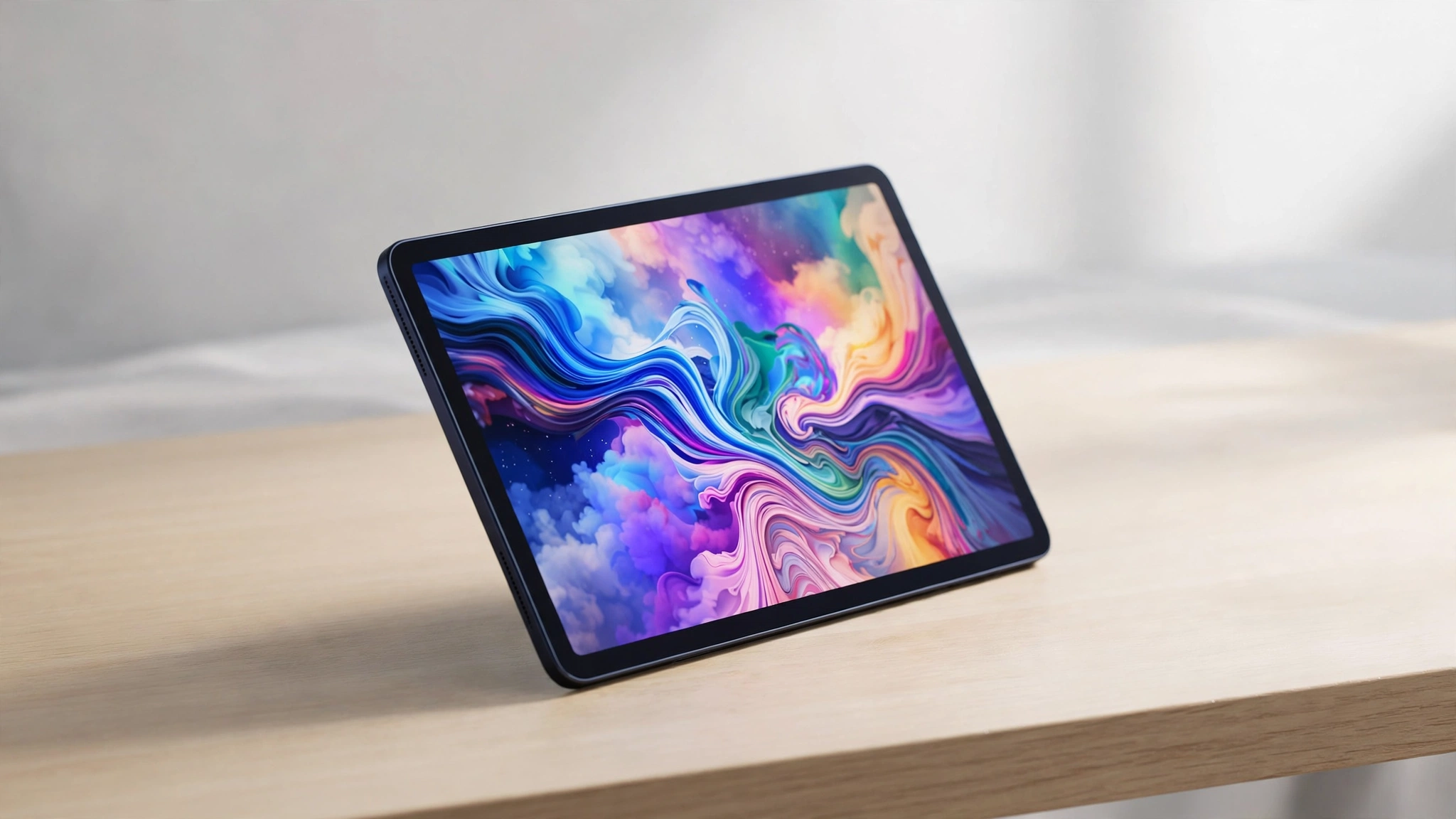
Apple did not wait for the stage. On Monday, October 26, the company announced its new iPad mini through a newsroom press release — two days before its “Pro and Tell” event in Los Angeles, where this tablet was widely expected to appear. The surprise is not that a new mini exists. It is how much of the tablet changed at once: the screen, the chip, the water resistance, even the way it makes sound. And the price went up, again. The new iPad mini starts at $699 for Wi-Fi and $849 for cellular. Pre-orders open Wednesday, October 28, and it reaches stores on Friday, November 6, in 36 countries including the US. If you were waiting for the event to decide, Apple has already given you the decision to make.
The OLED screen is the whole story
The headline upgrade is the display. The mini moves from an 8.3-inch LCD to an 8.5-inch Super Retina XDR OLED panel, with bezels 24% thinner so the larger screen fits in roughly the same footprint. Apple quotes 600 nits of full-screen brightness and up to 1,200 nits peak — more than double the previous generation — plus a 2,000,000:1 contrast ratio and P3 wide color. In practice, that means true blacks in a dark room and a screen that stays readable in bright light, the two things LCD minis never did well.
There is one asterisk worth knowing before you buy. Apple has not stated a refresh rate for the panel, and multiple outlets reporting from the spec sheet — GSMArena and 9to5Mac among them — list it at 60Hz, with no ProMotion. If you scroll fast or play fast games, that is the one spec where this tablet still feels like a mini rather than a Pro. The OLED upgrade is real; a high-refresh screen is not part of it.
Buyers who work in bright rooms get one more option: a nano-texture glass finish that cuts glare, borrowed from the iPad Pro. It costs an extra $100 and is only offered on the 256GB and 512GB models, not the base one.
A20 Pro power — with a storage-tier catch
Inside is the A20 Pro, the same chip family as the iPhone 18 Pro, built on a 2-nanometre process. Apple’s claims against the A17 Pro in the previous mini are big: up to 60% faster multi-threaded performance, up to 4.5 times faster AI performance, and up to 2.7 times faster graphics. The 7-core GPU carries Neural Accelerators in every core, which is Apple’s way of saying on-device AI work — the revamped Siri and Apple Intelligence features in iPadOS 27 — should feel instant rather than approximate. These are Apple’s figures, not independent benchmark results; no third-party test data accompanied the announcement.
Here is the detail Apple does not put in the headline. According to spec-sheet reporting from GSMArena, the chip configuration varies by storage tier: the 128GB and 256GB models get a 5-core CPU (two performance cores, three efficiency cores) with a single 16-core Neural Engine, while the 512GB model gets a 6-core CPU (two performance, four efficiency) and dual Neural Engines. Both have the same 7-core GPU. For most buyers the difference will be invisible, but if you plan to keep this tablet for five years and run AI features hard, the top tier is the one with the full chip. Check the spec sheet for the exact model you are ordering, not just the marketing name.
The first iPad you can get wet
The new mini is the first iPad with an IP67 rating for dust and water resistance. That matters more for this tablet than it would for a big iPad Pro, because the mini is the one people actually carry everywhere — in a jacket pocket, a bag side pocket, a kitchen, a boat. The engineering trick is one Apple calls the Acoustic Display. Instead of speaker cutouts, woofers work through the display itself, with custom tweeters sitting between the glass and the aluminum body. Sealing the speaker holes is part of how the tablet earns its rating, and Apple says the setup also improves bass and volume for games, video, and editing. It is a neat solution to a real problem: the smallest iPad is the one most likely to meet rain, and until now it was also the least protected.
The rest of the box: Apple’s own radios, better cameras
Connectivity moves fully to Apple’s own silicon. Every model uses the N1 wireless networking chip, and cellular models use Apple’s C2 modem with eSIM. Reporting also lists Wi-Fi 7 support, though Apple has not made that a headline claim. The USB-C port transfers data at up to 10Gb/s, and the battery is rated for up to 10 hours of web browsing or video, reaching about 50% charge in 30 minutes with a 35W or higher adapter.
Cameras get a practical reshuffle rather than a megapixel race. The 12-megapixel Center Stage front camera now sits along the landscape edge, which is how most people actually hold a tablet on a video call. The rear 12-megapixel wide camera records 4K video at up to 60 frames per second. Both Apple Pencil Pro and Apple Pencil (USB-C) are supported; older Pencil models are not listed, so check compatibility before assuming your old stylus carries over. At 5.4mm thick, the new mini is 14% thinner and 13% lighter than its predecessor, with the Wi-Fi model weighing 255 grams. It is still a one-hand tablet, just a noticeably sleeker one.
Price, pre-orders, and the $200 question
Here is the full pricing picture for Wi-Fi models: $699 for 128GB, $799 for 256GB, and $999 for 512GB. Cellular starts at $849 for 128GB. Colors are midnight and starlight — two finishes, down from the previous generation’s wider palette.
The price history is the awkward part. This tablet launched at $499 in 2024, rose to $599 in June 2026, and now starts at $699. That is $100 more than the current model and $200 more than the launch price, at a moment when memory prices are climbing across the industry. Apple has not attributed the increase to any single component, so treat the memory-market backdrop as context, not Apple’s explanation. What is certain is that the mini now costs nearly as much as an iPad Air, and buyers will reasonably ask whether the smaller screen is worth the premium. Apple’s answer is the OLED panel, the A20 Pro, and the IP67 rating — all firsts for the mini line.
Pre-orders open October 28 and the tablet arrives November 6. That timing is deliberate: it lands the mini in stores days before the holiday shopping season, and days after the October 28 event where Apple is still expected to show its touchscreen Macs and other hardware. Our preview of that event is here. For the broader Apple lineup, see also.
Who this is for, and who should skip it
Buy the new mini if you are a mini person already: readers, note-takers, pilots, field workers, and anyone who wants a full iPad that disappears into a small bag. The OLED screen alone fixes the old model’s weakest point, and the IP67 rating removes the anxiety of carrying it everywhere. Skip it — or at least wait for reviews — if you need a high-refresh display, if you already own the A17 Pro mini and mostly read and browse, or if screen size matters more than portability. At $699, a base iPad or an iPad Air buys you a bigger canvas for similar or less money. The mini has never been the value pick; it is the portability pick, and this generation leans into that identity harder than ever.
What to watch next: the October 28 event itself, and then the first independent reviews, which will settle the two questions Apple left open — whether the 60Hz panel bothers anyone in daily use, and whether the storage-tier chip difference shows up anywhere outside a benchmark. This is the biggest mini update ever by Apple’s own billing. The screen earns that claim. The price will decide whether buyers agree.
Also new today: GPT-6.1 Terra: Price, Speed & What It Can Do