Tag: Snapdragon 8 Elite Gen 5

  • OnePlus Ace 7 Pro: Price, Specs & Launch Details

    OnePlus Ace 7 Pro: Price, Specs & Launch Details

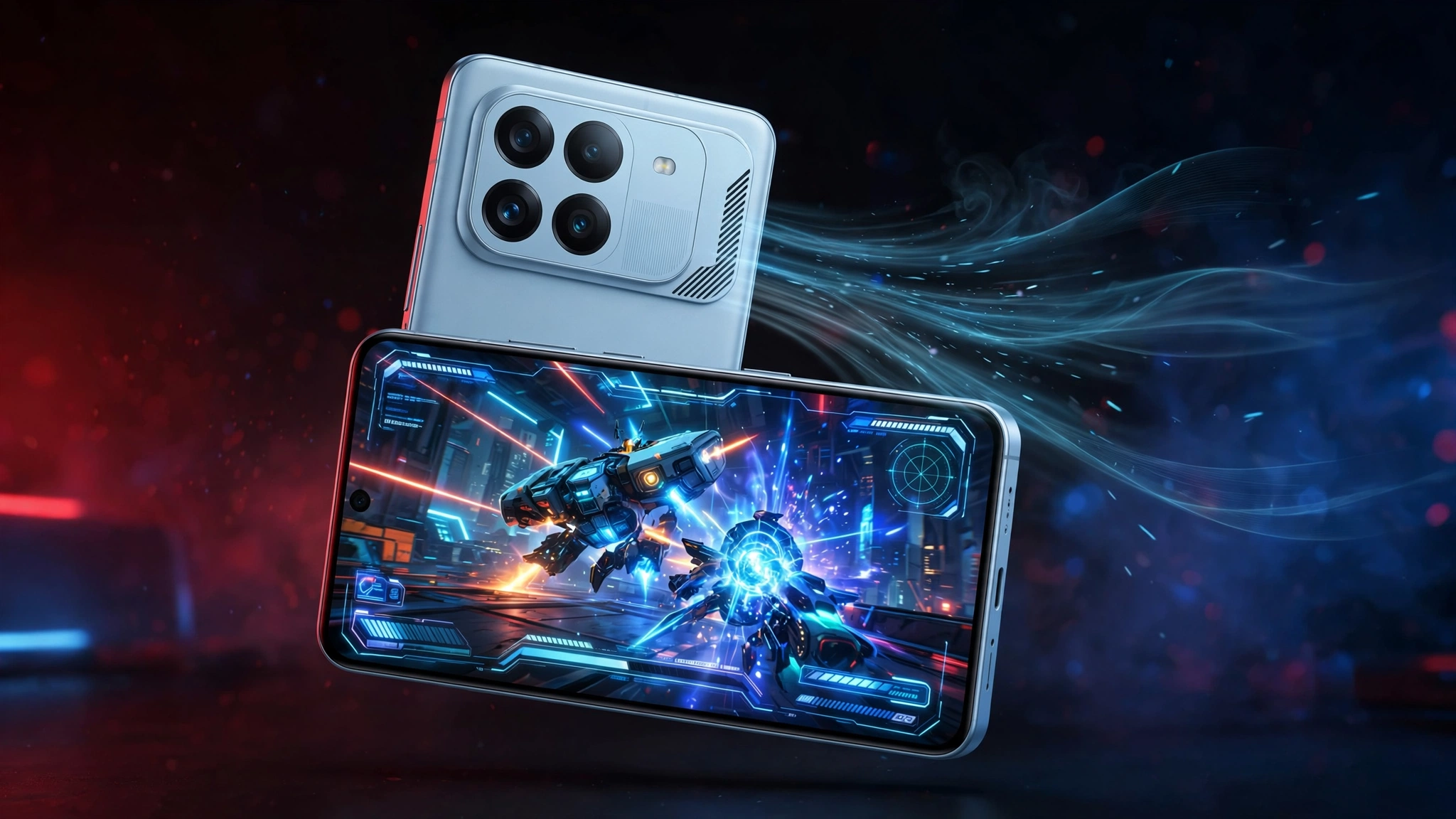
    OnePlus has put a fan inside a phone — and not as a gimmick accessory, but as the headline feature. The OnePlus Ace 7 Pro, launched in China on October 29, 2026 alongside the standard Ace 7, is the first Ace phone with active cooling built in. Around that fan, OnePlus has assembled just about everything a mobile gamer could ask for: a 185Hz display mode, a 9,000mAh battery, and Qualcomm’s newest flagship chip.

    There is a catch, and it is a big one for readers outside China: no global launch has been announced at all. So this is a launch worth understanding — and, for most of the world, a phone worth waiting on rather than importing on day one.

    The fan is the story

    Both Ace 7 models have a built-in active cooling fan, a first for the Ace line. The Pro gets the full version: a dual-path “Glacier” system with two intakes and two grilles, with vents positioned on the protruding camera island. One path cools the chip, the other cools the back panel, and the whole stack sits over a 6,350 mm² 3D vapour chamber.

    OnePlus claims the system keeps the chip area up to 10°C cooler after an hour of gaming at 185 frames per second. Treat that number for what it is — a manufacturer claim from OnePlus’s own testing, not an independent measurement. No launch coverage found an independent temperature test or even a fan-noise figure, and OnePlus’s own product page does not state what the 10°C is measured against. The honest version: the fan exists, the engineering is real, and the payoff is still unproven by anyone outside OnePlus.

    One detail in the coverage is worth flagging rather than smoothing over. Some outlets describe the standard Ace 7’s fan as skipping the Pro’s bi-directional airflow, while others describe the dual-path system as series-wide. The safe reading is that both phones have a fan, and the Pro gets the full dual-airflow layout.

    A display that changes its refresh rate depending on what you play

    Both phones share a 6.78-inch LTPO AMOLED display at 1.5K resolution (2,772 × 1,272), built on a BOE X4 panel. The refresh rate runs at 165Hz across the system — and only climbs to 185Hz in supported games. Any coverage that calls this simply a “185Hz display” is overselling it; the 185Hz mode is a gaming mode, not an always-on spec.

    Brightness is another figure to handle with care. Most launch coverage reports 2,000 nits peak global brightness, while one outlet lists a 3,600-nit peak figure — almost certainly a different measurement. The 2,000-nit global figure is the one to trust. Elsewhere on the display front: full DCI-P3 colour, 450 pixels per inch, and 3,840Hz PWM dimming.

    Two chips, one meaningful difference

    The Pro runs the full Snapdragon 8 Elite Gen 5. The standard Ace 7 runs a “V Series” variant of the same chip — and the difference is narrower, and more specific, than the name suggests. The CPU is unchanged: two prime cores up to 4.6GHz plus six performance cores up to 3.62GHz. What changes is the graphics side: the Adreno 840 GPU drops from three slices to two, with less dedicated memory (12MB instead of 18MB). Same CPU, weaker GPU — which is exactly the trade-off a gaming phone buyer should understand before saving money on the cheaper model.

    Both phones add a trio of gaming co-chips — a touch chip, a network chip, and a display chip — plus bypass charging, which routes power straight to the phone while gaming instead of cycling the battery. Both also carry LPDDR5X Ultra RAM and UFS 4.1 storage.

    Cameras: the Pro trades ultrawide for zoom

    Here the two models split in a way that genuinely changes who should buy which. Both share a 200MP main camera with optical stabilization and a 16MP front camera. After that, they diverge completely:

    – Ace 7: adds an 8MP ultrawide (112° field of view). No telephoto.

    – Ace 7 Pro: adds a 50MP periscope telephoto with 3.5x optical zoom and stabilization — and has no ultrawide at all. OnePlus reportedly dropped it to make room for the fan.

    So the choice is not “better camera or worse camera.” It is zoom versus ultrawide, and the right answer depends entirely on how you shoot. The Pro also records up to 8K at 30 frames per second and 4K at 120 frames per second with a Log mode; do not assume those video modes carry over to the standard model.

    Battery, charging, and the rest of the spec sheet

    Both phones pack a 9,000mAh battery with 100W wired SuperVOOC charging. OnePlus claims up to 7 hours of gaming at 185 frames per second or 24 hours of video playback — again, company claims, not independent tests. Wireless charging does not appear in the launch specs; the standard Ace 7’s spec listing says no, and for the Pro it is simply not listed. Reverse charging is genuinely disputed between outlets, so do not count on it.

    The rest is flagship-grade and shared: IP66, IP68, IP69, and IP69K dust and water resistance (impressive given the fan vents), ColorOS 17 based on Android 17, a 3D ultrasonic in-display fingerprint sensor, dual speakers, NFC, an IR blaster, Wi-Fi 7, and Bluetooth 5.4. Size and weight depend on the finish — around 8.5mm and 217–218g for the black and white models, slightly thicker and heavier for the special glass-backed finishes.

    Prices — and the sale-date confusion

    Chinese list prices, confirmed across multiple launch reports:

    OnePlus Ace 7 Pro: from CNY 4,799 (~$715) for 12GB + 256GB, rising through CNY 5,299, 5,599, and 5,999 to CNY 7,299 (~$1,090) for 16GB + 1TB — the Pro is the only model with a 1TB option.

    OnePlus Ace 7: from CNY 4,399 (~$655) for 12GB + 256GB up to CNY 5,699 (~$850) for 16GB + 512GB.

    Those dollar figures are outlet conversions, not official prices anywhere outside China. Ignore the wildly conflicting rupee conversions floating around launch coverage — they disagree by thousands on the same model.

    One more confusion to flag honestly: the first sale date. Most launch coverage lists November 3, 2026, via the Oppo online store in China, but some outlets reported sales and launch offers starting on launch evening, October 29. Rather than pick one silently, treat November 3 as the widely reported first-sale date and the launch-evening reports as a discrepancy in the coverage.

    Should you wait for a global version?

    This is the question that matters most, and the answer is: there is nothing to wait for yet, officially. OnePlus has announced no global, US, UK, European, or India launch. Rumours point to one of these phones arriving in India as the OnePlus 16R — but even that is disputed, with some outlets pointing to the vanilla Ace 7 and others to the Pro, and tipped prices and timing are all pre-launch leaks. Some coverage also notes that a US or European release looks unlikely given OnePlus’s reported pullback from those markets this year, though that comes from secondary outlets rather than a OnePlus statement.

    For buyers outside China, the practical advice is simple: do not import one yet on the strength of launch-day specs. No independent battery, thermal, or camera tests exist, no update-support commitment has been published for these China models, and the global version — if it comes — may differ in specs, software, and price.

    If you want a gaming phone you can actually buy today, our Honor WIN 2 coverage shows what the other fan-cooled flagship looks like — and if you are following the week’s other big platform news, the Samsung News app shutdown is the story that affects far more phones than any single launch.

    Sources: GSMArena, Beebom, Gadgets360, The Tech Outlook, GizmoChina, 91mobiles, TechRepublic, Notebookcheck, LockerGnome (all Oct 29–30, 2026). Prices are Chinese list prices; performance and battery figures are OnePlus claims unless stated otherwise.

  • iQOO Neo 12: Launch Date, Specs, Price & More

    iQOO Neo 12: Launch Date, Specs, Price & More

    iQOO Neo 12: Launch Date, Specs, Price & Everything We Know

    The iQOO Neo 12 is about to make its debut. iQOO has confirmed that its next gaming phone launches in China on October 28, 2026, with sales starting the same evening. It is a phone built around one idea: long, fast gaming sessions without the phone getting hot or running out of battery.

    iQOO has already confirmed a lot of the hardware through official teasers, including a 2K display running at 185Hz, Qualcomm’s Snapdragon 8 Elite Gen 5 chip, a dedicated Q3 gaming chip, an active cooling fan, and a 9,000mAh battery. What it has not confirmed is just as important: there is no official price yet, the display size is still unconfirmed, and there is no word on an international launch.

    Here is what is confirmed, what is only leaked, and what to watch for on launch day.

    iQOO Neo 12 Launch Date and Availability

    The iQOO Neo 12 launches in China on October 28, 2026, at 7 PM local time (4:30 PM IST). Pre-orders are already open in China through vivo’s online store, and iQOO says sales will begin immediately after the announcement — buyers will not have to wait days for the first units to ship.

    For now, this is a China-only launch. iQOO has announced no India or global date, and no US or UK plans at all. That is not unusual for the Neo line: the Neo 11 never launched in India, so an international Neo 12 is far from guaranteed.

    There are theories about a rebrand. Some reports suggest the phone could reach India and global markets in early 2027 as the iQOO 16R, possibly with a changed camera setup. Other reports argue the 16R is a separate device entirely, and point to the Z12 Turbo instead. Treat all of this as speculation until iQOO says something official.

    iQOO Neo 12 Specs: Display, Chip and Cooling

    The display is the headline feature. The iQOO Neo 12 uses a flat 2K OLED panel with a refresh rate of up to 185Hz, built with Visionox’s fourth-generation pTSF light-emitting technology, developed with Visionox and Tsinghua University. iQOO rates the screen at 2,200 nits of full-screen brightness, and it supports XDR dynamic range, circular polarisation, and a 1-nit sleep screen for very dim viewing.

    Touch response is equally aggressive: up to 5,000Hz instant touch sampling and 500Hz multi-touch sampling, using the same touch chip as the iQOO 16. iQOO claims more than 50 games will run natively at 185 frames per second at 2K resolution, with super-resolution and frame interpolation running at the same time, plus full-scene ray tracing and Q-Flex controls. Those are iQOO’s claims, not independent test results — but they show exactly who this phone is for.

    One detail is still fuzzy: the display size. Leaks have suggested both 6.78 inches and 6.83 inches, and iQOO itself has not confirmed a size. The safest way to describe it is a roughly 6.8-inch 2K 185Hz panel.

    Under the hood, the phone pairs Qualcomm’s Snapdragon 8 Elite Gen 5 with iQOO’s dedicated Q3 gaming chip and an updated Monster Super Core Engine. Note that this is not the very newest silicon in iQOO’s lineup — the iQOO 16 uses the Snapdragon 8 Elite Gen 6 — but the Gen 5 remains a flagship-class chip, and the Q3 handles the gaming-specific work like frame interpolation.

    Cooling is where the Neo 12 stands out from most gaming phones. It uses iQOO’s Ice Dome cooling system with a built-in active cooling fan, housed in the square rear camera module, plus side exhaust vents. According to iQOO teasers, the fan has 59 large blades with three-speed intelligent adjustment, working alongside an 8,200 mm² 3D Ice Dome vapor chamber that iQOO says improves heat dissipation by 15 percent over the Neo 11. Again, these are manufacturer claims, but a physical fan is a real differentiator — most phones rely on passive cooling alone.

    If you want a comparison point, check out our coverage of the Honor WIN 2 gaming phone, another phone that went all-in on active cooling with two physical fans.

    Battery and Charging

    The battery is the second headline. iQOO has confirmed a 9,000mAh Blue Ocean battery — a single-cell design using fifth-generation silicon-anode and second-generation semi-solid-state technology, with an energy density of 916Wh/L. That is 20 percent larger than the 7,500mAh cell in the Neo 11.

    Charging is 100W wired, and iQOO claims up to 11.6 hours of MOBA gaming or 29.9 hours of continuous short-video playback on a single charge. Those endurance figures are iQOO’s own claims and have not been independently tested yet.

    The phone also supports Global Direct Drive Power Supply 2.0, iQOO’s bypass charging feature. During gaming, navigation, or video playback, power can go straight to the system instead of through the battery, which means less heat and less long-term battery wear while you play plugged in.

    For context on how battery sizes have ballooned this year, see our Redmi K100 launch coverage — that phone packs an even bigger 10,000mAh cell and launches in China on October 27, just one day before the Neo 12.

    Cameras and Design

    iQOO confirmed the main camera on October 23, alongside official camera samples. The iQOO Neo 12 has a 50MP Sony IMX921 main camera with optical image stabilization, plus portrait film styles and a high-resolution mode. The sample shots released so far include portraits, an upward shot of a glass-roofed atrium, and a close look at an ornate traditional ceiling.

    Everything else about the cameras is unconfirmed. Leaks consistently suggest an 8MP ultrawide and a 16MP front camera, but another leak claims a second 50MP rear sensor instead of the 8MP ultrawide. Until October 28, do not treat either version as fact.

    The design is confirmed: a polished metal frame, a flat display with thin, even bezels and a centred punch-hole camera, and a large rounded-square rear camera island with two vertically arranged lenses and a circular mesh grille beside it — the fan intake. It comes in three colors, including a textured flowing-light finish developed with the China Academy of Art (translated in some reports as Zhengfeng, Contest, or Fierce Edge), plus Shadow Black and Frost Blade Blue.

    Price: What We Know So Far

    Here is the honest answer: iQOO has announced no price and no storage configurations. Any price you see quoted before October 28 is a leak or an estimate, not a fact.

    The leaked ranges do not even agree with each other. Some estimates put the phone around CNY 2,999–3,299, based on the Neo 11’s CNY 2,599 launch price plus 2026 flagship price rises. Others suggest CNY 3,299–3,599. India pricing guesses are even further apart, ranging from roughly ₹45,000–59,999 in one report to ₹70,000–75,000 in another. That gap is too wide to be useful, so we are not picking a number here — the real price arrives on October 28.

    For context, the Neo 11 launched at CNY 2,599 for 12GB + 256GB, while the flagship iQOO 16 starts at CNY 5,999. The Neo 12 should land somewhere between those two poles, closer to the Neo 11 end.

    What Is Still Unknown

    To sum up the open questions ahead of launch day:

    • Price and storage options — nothing official yet.
    • Display size — leaks say 6.78 or 6.83 inches; iQOO has not confirmed either.
    • Secondary and front cameras — 8MP ultrawide + 16MP front is the most common leak, but a second 50MP sensor is also rumored.
    • RAM and software — 16GB RAM and Android 17 appear only in a Geekbench listing, not from iQOO.
    • Durability and extras — IP68/IP69 ratings, an in-display ultrasonic fingerprint scanner, and dual speakers are all leaked, not confirmed.
    • International launch — no date, and possibly a rebrand as the iQOO 16R in early 2027, or no launch outside China at all.

    Should You Wait for the iQOO Neo 12?

    If you play demanding mobile games for hours at a time, the iQOO Neo 12 is shaping up to be one of the most interesting phones of the year: a 2K 185Hz display, a flagship chip plus a dedicated gaming chip, a real cooling fan, and a 9,000mAh battery with 100W charging is a combination almost no other phone offers. The catch is availability — if you are outside China, you may be waiting months, or the phone may never arrive under this name.

    The smart move is to wait for October 28. The price, the full camera setup, and the display size will all be confirmed then, and we will update this article with the official details. Also check out Apple’s big announcements the same week — our Apple October 28 Pro and Tell event preview covers the touchscreen MacBook Pro, M6 Macs, and OLED iPad mini expected at the event.