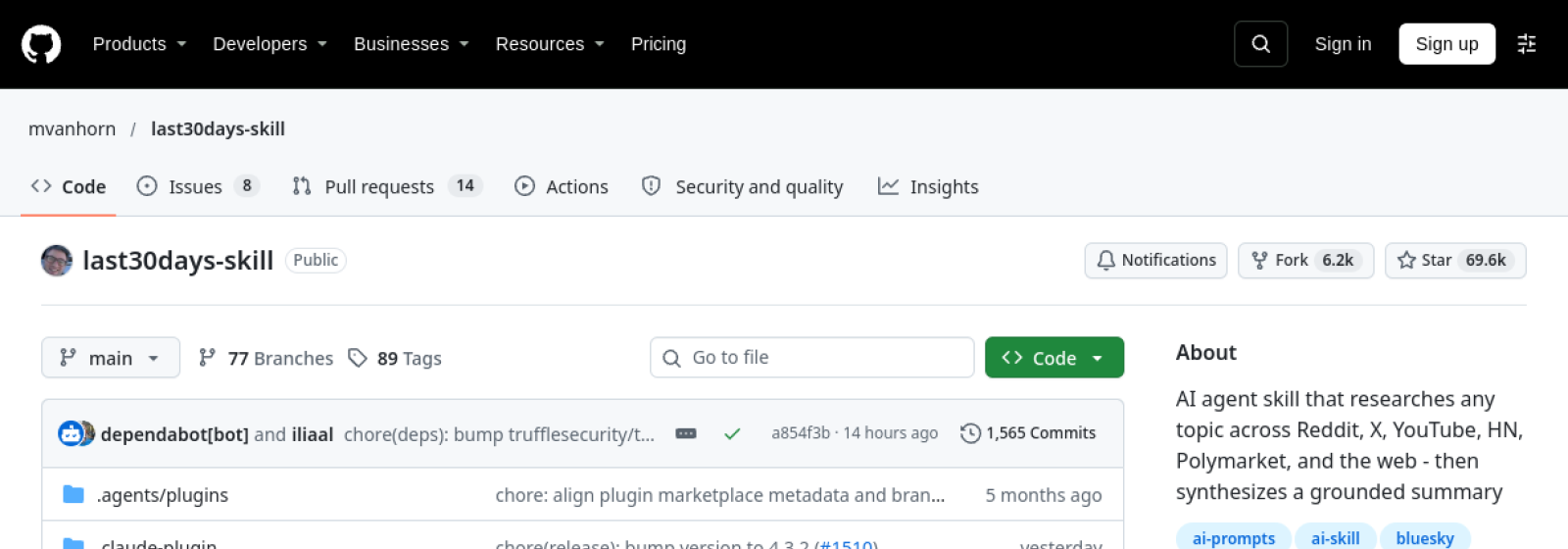
There is a specific kind of research that Google has quietly stopped being good at: what are real people actually saying about this thing, right now? Search a topic and you get SEO-polished blog posts, press releases, and three-year-old listicles. The Reddit thread where practitioners argue about the actual problem, the X thread from the engineer who shipped it, the 45-minute YouTube deep dive, the prediction market where people put money on the outcome — none of that shows up in a normal search. last30days exists to go and get it, and this morning it is the fourth most-trending repository on GitHub, with about 69,600 stars and more than 1,000 new ones in the last day alone.
The pitch is one sentence long, and it is the best sentence in the README: “Google aggregates editors. /last30days searches people.” You give your coding agent a topic — a person, a company, a product, “X vs Y” — and the skill searches Reddit, X, YouTube, TikTok, Hacker News, Polymarket, GitHub, and the open web in parallel, scores everything by what real people actually engaged with, and has an AI agent judge synthesize it into a single brief. Not a pile of links. A brief, grounded in specific data, with quotes and upvote counts attached to the claims they support.
Screenshot: github.com/mvanhorn/last30days-skill — the README’s banner and its “#1 Repository Of The Day” badge.
Why upvotes beat editors
The idea behind the tool is disarmingly simple, and it is the reason it has resonated. A Reddit thread with 1,500 upvotes is a stronger signal than a blog post nobody read. A TikTok with 3.6 million views tells you more about what is culturally relevant than a press release. Polymarket odds backed by $66,000 in volume are harder to argue with than a pundit’s guess. The skill’s author built it to keep up with AI, where everything changes daily and, in his words, “the Reddit and X nerds are always on top of it first” — training data is always months behind what the community has already figured out.
That framing matters because it explains what the tool is not. It is not a search engine and it is not a chatbot with web access. It is a research agent that treats engagement as the ranking signal: social relevancy instead of SEO relevancy. The same story showing up on Reddit, X, and TikTok gets merged into one cluster instead of three separate items, and the synthesis ranks by what people actually engaged with. The README’s worked example makes the point well. Ask it about a person before a meeting and it returns what they have actually been doing this month — the GitHub PRs, the X arguments, the podcast transcripts — instead of a LinkedIn profile from 2023.
Thirty-plus sources, and the free ones work first
The source list is the longest I have seen on a tool like this, and the honest part is that the useful core costs nothing. Reddit with comments, Hacker News, Polymarket, GitHub, and StockTwits work immediately with no API key, and so do patent filings and careers pages when your topic is a company. arXiv, Techmeme, and Yahoo Finance are covered by free command-line tools the first-run setup installs for you. YouTube transcripts come through yt-dlp, which is free. Bluesky needs only an app password.
The sources that cost something are the ones that would cost something anywhere. X needs either an official API bearer token (your own X developer project, with its own credits), a logged-in browser session, or an xAI key. TikTok, Instagram, Threads, Pinterest, LinkedIn, and YouTube comments run through a ScrapeCreators key, which gives you 10,000 free calls and then charges pay-as-you-go. Perplexity’s agent API is pay-as-you-go, and Brave Search gives you 2,000 free queries a month. The skill degrades gracefully — skip every key and it still works in web-only mode — but the honest version of the pitch is that the full “search everything” experience is free only up to a point, and the point depends on which platforms you care about.
The v4 trick: reading what a company hasn’t announced yet
The current version, v4, adds the feature that turns this from a neat research tool into something genuinely hard to replicate by hand. Run it on a company and it reads that month’s US patent filings and the company’s own careers page, then flags only the ones that give something away. The README calls these Secret Signals, and the examples are striking: a job posting for a director role testing whether requests trigger transactions through partner APIs, which reads like quality control for an assistant that completes purchases; a patent application for changing a device’s state by tapping a saved photo of your room. It also pulls a Yahoo Finance line — the share price over the last 30 days next to the S&P 500, with the biggest single-day move — and a Polymarket odds line under the story it bears on, with how far the odds moved.
There is also a discovery mode for when you do not have a topic yet. Ask what is exploding in AI agents and the skill sweeps Reddit categories, Hacker News, Digg, and X, has the model judge the nominations, and hands you five to ten velocity-ranked topics with a ready-to-run follow-up command for each. And once you have run it a few times, it keeps a local library: saved briefs become a searchable archive, an Atom feed you can host on GitHub Pages, and a watchlist mode with Slack or webhook delivery for scheduled runs. That is a lot of machinery for a free skill, and it is all local — by default, nothing leaves your machine except the calls to the search APIs you choose to use.
Installing it takes about a minute
For Claude Code users, the recommended route is the marketplace:
/plugin marketplace add mvanhorn/last30days-skill
/plugin install last30days
Everything else goes through the open Agent Skills standard, which is the part that makes this more than a Claude Code curiosity. One command installs it on Codex, Cursor, Copilot, Gemini CLI, and more than 50 other hosts:
npx skills add mvanhorn/last30days-skill -gThere is also a Grok plugin, an OpenClaw install through ClawHub, a downloadable skill file for claude.ai on the web, and a one-click MCP bundle for Claude Desktop — though that one needs Python 3.12 or newer on your machine, and Windows support for the desktop bundle is deferred. The project is MIT-licensed, created in January 2026, and has 1,565 commits across 83 releases, with version 4.3.2 current as of this week. The runtime spec lives in the skill’s SKILL.md file, which the README says is the source of truth for the latest command and setup behavior.
Who should install it, and who should not
This is for anyone whose work starts with “what is actually going on with X?” — developers tracking a fast-moving ecosystem, founders researching a competitor or a hire, content creators who currently spend 90 minutes opening tabs thread by thread before writing. One user quoted in the README says the skill replaced their entire research workflow; another says it eliminated the tab-by-tab slog before every piece of content. If you already use Claude Code or a similar agent daily, this slots into a workflow you already have, and the zero-config free sources mean you can try it before spending anything on keys.
It is not for everyone. If you just want a quick answer, a normal search or a chatbot is faster — this is a research run, not a question box. If you need verified, citable facts for publication, treat the brief as a starting point and check the sources it cites, because engagement is a signal of what people care about, not of what is true: upvotes can be gamed, a viral take can be wrong, and Polymarket odds are a market’s opinion, not a fact. And if your topic lives mostly on platforms that need paid keys, budget for that before you commit — the free tier is generous, but the full sweep is not free.
The caveat that matters most is the one the project states plainly in its own data-handling section: if you configure a reasoning provider key, your topic and retrieved snippets go to that provider for relevance scoring, and some sources work by reading your logged-in browser sessions. That is the price of searching walled gardens, and it is opt-in — with no reasoning key set, the engine falls back to a local scoring model and makes no external reranking call. Your research files stay local by default, in a folder you can move or delete.
last30days is not trying to replace Google. It is trying to answer the question Google stopped answering well: what do the people who actually know about this think, and what have they said in the last thirty days? At 69,600 stars and climbing, a lot of people seem to have been waiting for exactly that.
Also today: NVIDIA’s record $115.8 billion quarter — its first report since Jensen Huang resigned, and GTA 6’s reviews are in, and it’s a 99 on Metacritic. If you build with AI agents, also see our coverage of AG-UI, the free standard connecting agents to apps, Plannotator, the free workspace for reviewing your agent’s work, and Google Skills, the agent-skills library for Google Cloud.