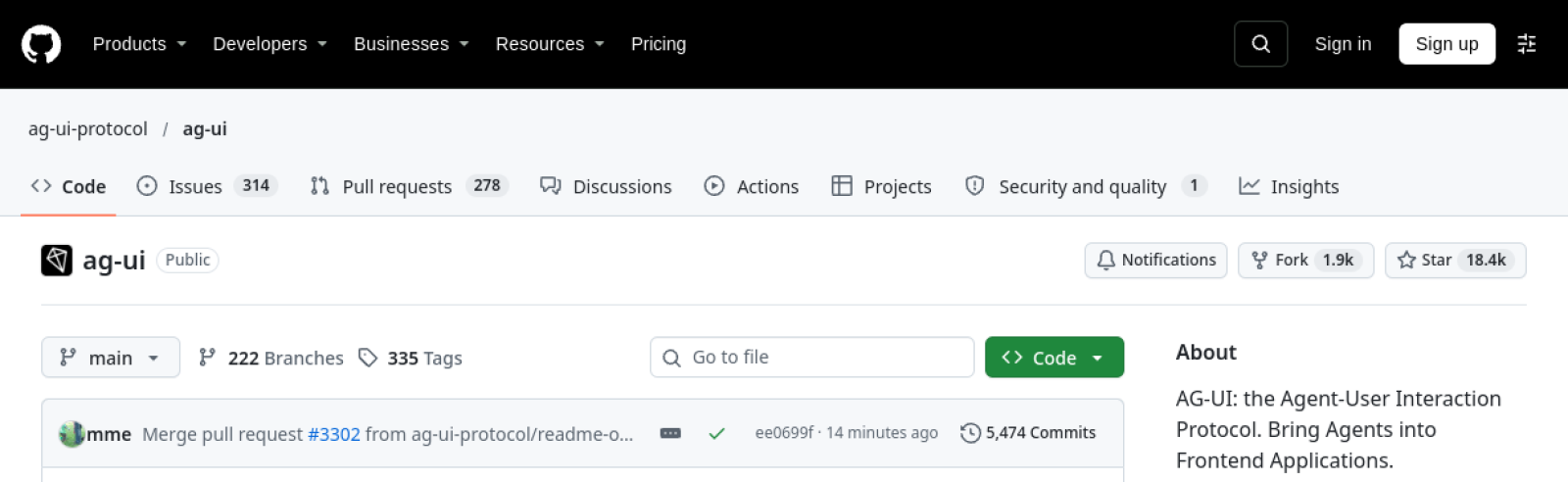
AG-UI is the number one trending repository on GitHub today, and it is not a tool. It is a protocol — a free, open standard for how an AI agent talks to the app in front of you. The repository, ag-ui-protocol/ag-ui, has about 18,400 stars, 1,900 forks, and a version 1.0 specification that froze just six weeks ago. If you have built anything with an AI agent in the last year, you have felt the problem it is trying to solve, even if you did not have a name for it.
Agents do not fit the request-and-response model. They stream tokens, call tools in the middle of an answer, update shared state, pause to ask a human a question, and hand work off to subagents — and every framework wires all of that to the frontend differently. So every team that ships an agent ends up inventing a private streaming format, and every new backend forces a frontend parser rewrite. AG-UI replaces that custom wiring with one bi-directional event stream: the agent emits typed events, and any client can render them, no matter which framework built the agent. The same agent can power a web app, a mobile app, a terminal, or Slack.
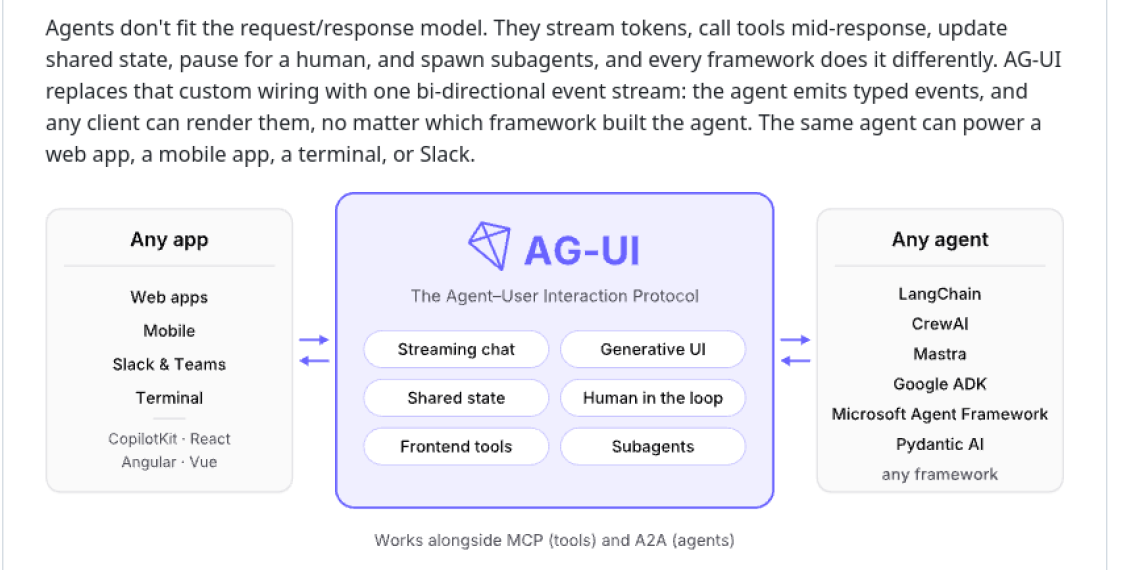
Screenshot: github.com/ag-ui-protocol/ag-ui — the README’s diagram: any app on one side, any agent framework on the other, AG-UI in the middle.
What it actually carries
The protocol is event-based, and version 1.0 defines 31 event types in eight families: run lifecycle, text messages, tool calls, state, reasoning, activity, subagents, and custom passthrough events. Only the run lifecycle is required, so a minimal agent can emit a handful of events and still speak the protocol. A chat UI streams text; AG-UI streams the whole run — the tool call in progress, the state change, the reasoning as it happens, the subagent’s work, the pause where a human has to approve something — so the frontend can show what the agent is doing, not just its final answer.
That is the difference that matters in practice. A support copilot that only streams text looks like a chatbot with a delay. The same copilot on AG-UI can show the ticket it is reading, the draft it is writing, and the moment it stops to ask you whether to send it. The features list reads like a checklist of the things agent apps keep re-implementing: streaming chat with cancel and resume, generative UI, a typed shared state store synced with snapshots and JSON Patch deltas, frontend tools the agent can call in the browser, human-in-the-loop interrupts where a run ends, waits for approval, and resumes, reasoning display including encrypted reasoning round-trips, subagent delegation with every event attributed to the run that produced it, and multimodal input — images, audio, video, documents.
It is transport-agnostic: the spec defines HTTP plus server-sent events and HTTP plus Protobuf bindings, and middleware can adapt events from any source. The spec is backed by a JSON Schema, and the TypeScript, Python, and .NET SDKs are generated from it — that is the change version 1.0 made, when the spec froze on September 30, 2026. Version 1.0 is backwards compatible in both directions: 0.x agents work with 1.0 clients and vice versa.
Who is already speaking it
The integration table in the README is long and real. On the agent side: LangChain, CrewAI, Microsoft Agent Framework, Google ADK, AWS Strands Agents, Mastra, Pydantic AI, LlamaIndex, Agno, AG2, and the Claude Agent SDK, plus more than a dozen others including OpenAI Agents and Spring AI. On the client side, CopilotKit — React, Angular, Vue, and React Native — is the first-party client, alongside Slack and Teams, terminal clients, and OpenBot. Community SDKs cover Kotlin, Go, Java, Dart, Rust, Ruby, C++, and Swift.
The project says it is adopted by Google, Microsoft, Amazon, and Oracle, and built into most agent frameworks. That is the project’s own claim, and it should be read as one: secondary sources repeat the same four names citing CopilotKit’s own announcement, and I found no first-party confirmation from any of the four companies. What is independently verifiable is narrower but still meaningful — Microsoft’s Agent Framework added AG-UI hosting in its September 2026 update, stable in Python and in preview in .NET. The npm badge on the README shows 6.3 million downloads a week, and the repository itself is very alive: 5,474 commits, 78 releases, 181 contributors, and a push within hours of this article being written.
How to try it in ten minutes
The fastest path is the scaffold. One command:
npx create-ag-ui-app@latestIt builds a frontend — CopilotKit on Next.js, or a terminal client — wired to the agent framework you pick. The generated templates call OpenAI, so you will need your own API key before running it. If you would rather speak the protocol directly, the README walks through a minimal version in about thirty lines: a Python server with pip install ag-ui-protocol fastapi uvicorn that streams a run-started event, a few text-message events, and a run-finished event, and a Node client with npm install @ag-ui/client tsx that prints “Hello from AG-UI!” as it streams in. The point of the demo is the sentence underneath it: swap the server for any supported framework and the client does not change.
Requirements are modest — Python 3.9 or newer for the server example, Node.js 20 or newer for the client. The docs live at docs.ag-ui.com, the examples and live demos at dojo.ag-ui.com, and the spec alongside the docs.
What it costs — and what it does not do
The protocol and the SDKs are free. AG-UI is MIT-licensed, open source, and there is no AG-UI API key — the bare-protocol demo needs no key at all. The real cost is the language model behind your agent: the scaffolded templates call OpenAI, so you pay OpenAI’s per-use billing, and whatever framework or model you plug in carries its own cost. The README carries a banner — “Running AG-UI in production? Talk to the team” — pointing at a commercial path through CopilotKit, but no price or plan is published, so do not expect a number here.
It is also worth being precise about what AG-UI is not, because the agent-protocol space is now crowded enough to confuse anyone. It is not a replacement for MCP, and it is not a replacement for A2A. The README’s own framing, backed by independent explainers, is that the three are complementary layers: MCP gives agents tools and context, A2A lets agents work with other agents, and AG-UI brings agents to users. A single agent often uses all three. Google’s A2UI, which shipped version 1.0 on November 13, is a different layer again — it describes what UI to show, while AG-UI is the runtime protocol that carries those payloads between agent and app.
The honest caveat
The spec is stable; the ecosystem around it is not yet. Version 1.0 froze the protocol only on September 30, and the releases page still shows breaking-change notes on recent integration releases — a required peer dependency here, a renamed accessor there. The protocol will not break under you, but the SDKs and integrations are still moving fast, so pin your versions and expect upgrade work. There are 592 open issues on a fast-moving monorepo, which is the normal shape of a project this active, not a warning sign on its own.
The other caveat is governance. AG-UI started at CopilotKit, a vendor, and is developed in the open with the community — but there is no neutral foundation behind it yet. For a protocol whose whole pitch is that it is the standard layer between agents and apps, single-vendor stewardship is the thing to watch. If it becomes the default, the question of who controls the spec will matter more than it does today.
Who should use it, and who should not
It is for developers building apps where an AI agent works visibly in front of users — coding assistants, research agents, support copilots, dashboards — especially teams using LangChain, CrewAI, Mastra, Google ADK, or Pydantic AI who are tired of hand-rolling a streaming format for every backend, and anyone who wants one frontend to talk to agents from several frameworks. It is also, frankly, for anyone who has already built the private-format version of this problem and is maintaining it.
Skip it if you just need a simple chatbot — plain streaming text is enough, and AG-UI is overkill — if you have no agent backend at all, or if you only need agent-to-tool access or agent-to-agent messaging. Those are MCP’s and A2A’s jobs, and AG-UI says so itself.
AG-UI is the fourth agent-tool project this site has covered in ten days, after Google Skills, Agent-Browser, and Plannotator — and it is the first of the four that is not a tool at all. It is the layer underneath the tools, the part that decides whether your agent can show its work. That is why it is trending, and why it is worth a morning of your time even if you never touch the protocol itself.
Also today: NVIDIA reports Q3 earnings tomorrow — the first results since Jensen Huang resigned and GTA 6 launches Thursday — the unlock times, embargo and bonus deadline.
Leave a Reply