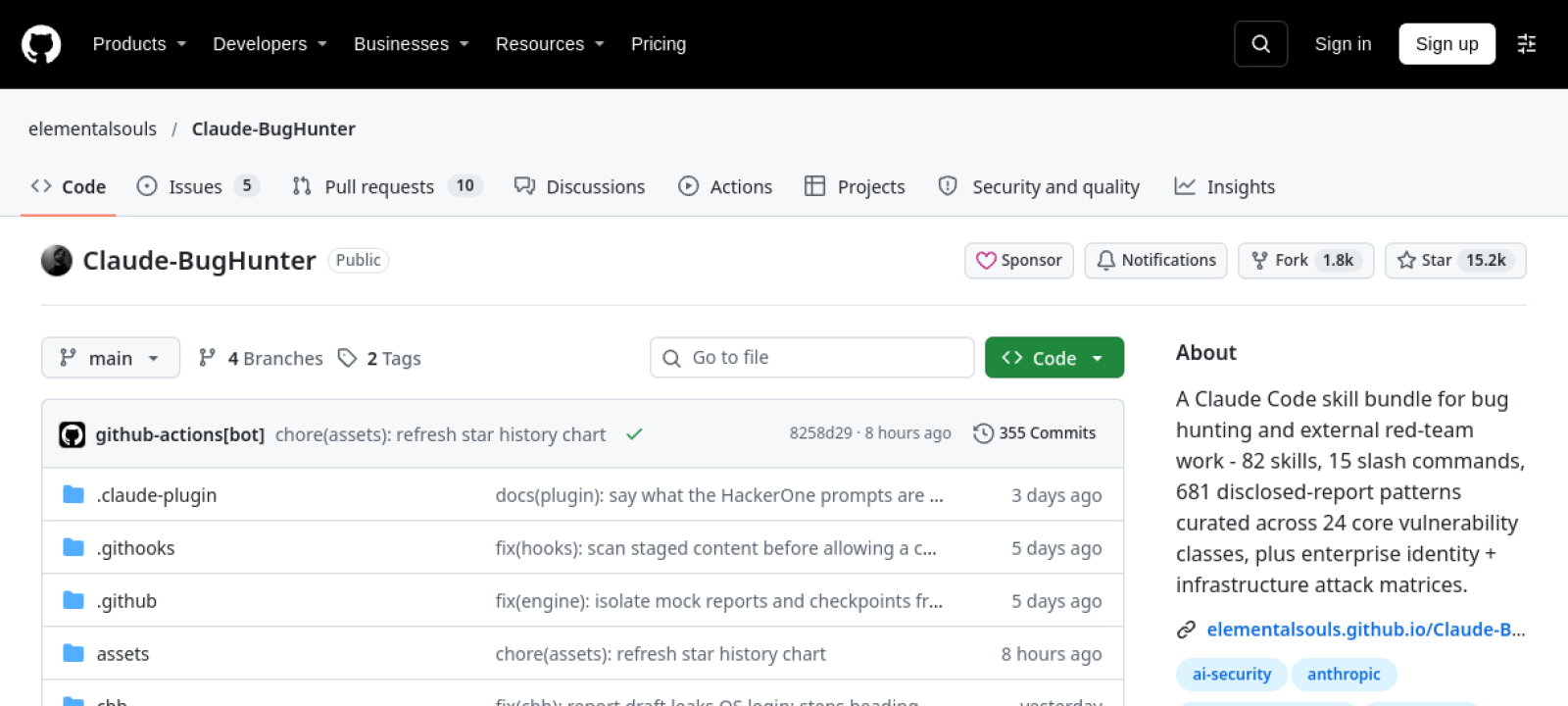
The most-starred repository on GitHub today does not contain a scanner. It does not contain a crawler, or exploit code, or anything that finds a bug on its own. What it contains is knowledge: 83 skills that teach Claude Code how to hunt bugs the way experienced researchers do, distilled from 681 real, paid-out HackerOne reports.
That distinction matters, because the name invites the wrong assumption. Claude-BugHunter, by elementalsouls (Sachin Sharma), is a drop-in skill bundle for the Claude Code skills system. It turns Claude Code into a guided bug-hunting and external red-team assistant — guided being the operative word. A human aims it, validates each finding, and writes the report. The bundle supplies the playbook.
It is also, by a distance, the fastest-growing repo on GitHub this week. It had 7,372 stars on November 17. By the morning of November 21 it had 15,210, with 1,764 forks — more than doubling in four days, and still sitting at number one on the trending page.
Screenshot: github.com/elementalsouls/Claude-BugHunter
What is actually in the bundle
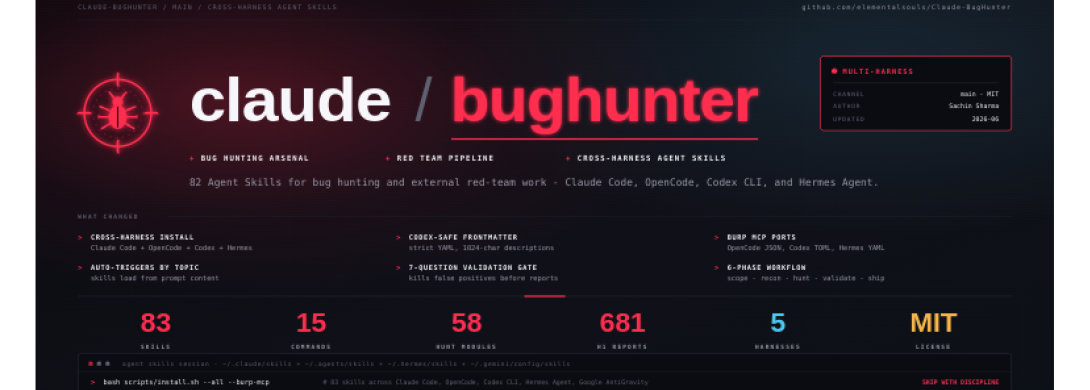
The headline numbers, verified on the live repo page: 83 skills, 15 slash commands, 681 disclosed-report patterns across 24 core vulnerability classes, of which 433 are individually cited so a pattern can be traced back to the disclosure it came from. The patterns are curated from 681 publicly disclosed HackerOne reports — real reports researchers wrote and triagers paid for, not textbook OWASP lists. The README’s framing is blunt: “Claude knows the actual chain templates real triagers paid for, not abstract OWASP Top 10.”
One small discrepancy worth noting because the repo itself wears it in public: the short description on the repo page still says 82 skills, while the README headline, the catalog table, and the banner all say 83. The README is the current document; use 83.
The skills fall into four layers. Fifty-eight are hunt skills covering web-app vulnerability classes — XSS, SQL injection, SSRF, IDOR, local file inclusion, server-side template injection, XXE, CSRF, CORS, open redirect, GraphQL, OAuth, JWT, file upload, SharePoint, ASP.NET/NTLM, and more. Ten cover enterprise platform attack: Microsoft 365 and Entra, Okta, cloud IAM, vCenter, enterprise SSL-VPN appliances from Cisco, Fortinet, Citrix, Palo Alto, Pulse, SonicWall, and F5, plus Android APK red-team pipelines and supply-chain reconnaissance. Six handle reporting and validation, including triage validation, evidence hygiene, and report writing for HackerOne, Bugcrowd, Intigriti, and Immunefi. Five cover recon and OSINT. Four more carry the methodology itself: bug-bounty method, red-team mindset, and a local toolkit.
The provenance is documented in the repo. Forty-three skills are original; eight are vendored from upstream shuvonsec/claude-bug-bounty (methodology, validation, reporting, and the payload library, including the 15 slash commands); the rest came from a community expansion that added twenty-plus framework and surface skills. The hunt skills were scaffolded from HackerOne disclosed reports using a public skills-builder tool.
The workflow is a six-phase loop — recon, map and rank, hunt, validate, report — that is deliberately non-linear: findings send you back to recon, validation failures send you back to hunting. Before anything is submitted, a 7-Question Gate checks the finding. And scope is enforced in code on the engine path: a JSON allowlist with default-deny, deny-wins matching against host name, wildcard, exact host, CIDR, and regex, with a /scope pre-flight check before any request touches a host.
Installing it, and what it costs
There are two main ways in. The recommended route is the Claude Code plugin, run from inside Claude Code:
/plugin marketplace add elementalsouls/Claude-BugHunter
/plugin install claude-bughunter@elementalsouls
All 83 skills and 15 commands load namespaced under claude-bughunter:, update when you bump the plugin version, and nothing is copied into ~/.claude/. The alternative is a copy install — clone the repo and run bash scripts/install.sh (macOS/Linux) or pwsh ./scripts/install.ps1 (Windows), which copies the skills into ~/.claude/skills/, the commands into ~/.claude/commands/, and wires the hunt engagement scaffolder, backing up any same-name skills it replaces.
The skills are standard Agent Skills format, so one install also works in OpenCode, OpenAI Codex CLI, Hermes Agent, and Google AntiGravity via bash scripts/install.sh --all --burp-mcp. The slash commands and the /hunt engine stay Claude-Code-only by design. There is also a standalone cbh command-line runner, installable with pipx install git+https://github.com/elementalsouls/Claude-BugHunter.
The bundle itself is free — MIT for the code, Creative Commons BY 4.0 for the content (methodology, wordlists, documentation), with attribution to Sachin Sharma and Claude-BugHunter required on redistribution. What you pay for is Claude usage: you need Claude Code, and a Pro, Team, or Max subscription per the install prerequisites, plus Python 3.9 or newer for the cbh runner. A HackerOne account is optional — the install asks for an API username and token, but only so the HackerOne MCP can read your private programs and your own reports; leave both blank and every skill, command, and public tool still works. Burp Suite is optional too; without it, cbh runs in curl-only mode and, per the install docs, “everything still works.”
One cost detail is easy to miss. The maintainers’ own evaluation found the engine dispatches agents with skills switched off by default because they showed roughly zero capability gain while costing around 12,000–15,000 tokens per agent. Automated testing is opt-in (--hunt), and state-changing tests need a separate --allow-intrusive flag. A plain engine run only maps the surface, with no agents and no model spend. That is the design working as intended — but it means the meter runs when you actually start hunting, and the bill is yours.
How a hunt actually works
In practice there are two ways to drive it. The first is plain English: describe the target, and the right skill loads automatically. The README’s worked example — flagged in the README itself as an illustrative transcript, not a recorded run — has a user testing an in-scope HackerOne target and asking for recon and a ranked surface. The bundle loads the recon, OSINT, and methodology skills, enumerates subdomains, filters live hosts, fingerprints the stacks, ranks the surface, and then asks before probing further.
The second way is the /hunt scaffold with the cbh CLI and a deterministic engagement engine: engagement folders with scope, targets, findings, evidence, and submissions, plus state and orchestration. A smoke test in the install docs tells you what to expect — ask a fresh Claude session about reflected input rendered into HTML and the hunt-xss skill should trigger; run /triage on a hypothetical finding and the 7-Question Gate should appear.
The reporting side is where the bundle’s HackerOne DNA shows most clearly. /report produces copy-paste-ready reports formatted for HackerOne, Bugcrowd (with VRT-aware severity), Intigriti, and Immunefi, plus client-facing red-team deliverables, with out-of-scope rebuttals, PII redaction, and evidence hygiene built in. For beginners, the README points at the usual practice targets: DVWA, OWASP Juice Shop, Hacker101, and testphp.vulnweb.com.
It is equally specific about what it does not do. Internal Active Directory attacks (BloodHound, Kerberoasting, DCSync, pass-the-hash), C2 frameworks, post-exploit persistence and lateral movement, evasion techniques, iOS pentesting, hardware and RF work, and binary exploitation are all explicitly out of scope by design. This is an external-attack-surface tool: web apps, APIs, SaaS, and the enterprise edge. If you are looking for an internal network pentest kit, this is not it.
The caveat that has to come first
None of the above matters without the authorization rule, which the bundle states plainly and which bears repeating in full: only test systems you own or have written authorization to test — in-scope bug-bounty assets, signed pentest engagements, CTFs, your own infrastructure, or the practice targets above. Testing outside a program’s published scope is illegal in most countries regardless of intent, and many programs ban or rate-limit automated testing. Read the program rules first.
The bundle’s own guardrails are real but limited, and an independent review by fervorai.dev — the most critical read of the repo so far — is worth quoting on this point. The 7-Question Gate and the /scope check are instructions the model can skip in plain-English mode; only the engine’s Python allowlist is enforced in code. Even there, dispatched agents run with permission prompts bypassed and curl allowed, so the review recommends a network allowlist as the real wall. Anthropic’s own safeguards add another wrinkle: Claude’s real-time cyber safeguards block vulnerability exploitation and offensive-security tooling development by default, and even authorized work can be refused until you enroll in Anthropic’s free, application-based Cyber Verification Program. On Opus 5, higher-risk cyber requests can silently fall back to Opus 4.8 with a label that is easy to miss in a long run.
There is also a limit on what the 681 patterns can promise. Disclosed reports skew toward what programs chose to publish, and the patterns are a snapshot that ages — refreshing them with newer reports is listed as open roadmap work. And there is no independent validation that the skills find bugs a skilled hunter would miss: one hands-on review on dev.to concluded, lukewarmly, that the bundle “didn’t find a bug I couldn’t spot.” The project’s own claim of validation through authorized engagements is the project’s claim, not a verified fact.
Why it is trending, and what it is not
It is worth saying plainly how this differs from the last security tool covered here. OpenAI’s Codex Security, from November 12, is a scanner appliance: it finds vulnerabilities, validates them in a sandbox, and patches them. Claude-BugHunter is the opposite shape of tool — a guided checklist and playbook that makes a capable human hunter faster and a learner better. It finds nothing by itself, runs no scans, and writes no patches. The contrast is the point: one automates the work, the other teaches it.
That is probably why it is trending. The agent-skills wave has spent the year packaging expertise into installable bundles, and bug hunting is expertise that is unusually hard to package — it lives in disclosed reports, triager notes, and hard-won chain templates, not in documentation. Claude-BugHunter is the most complete attempt yet to put that knowledge where an agent can reach it, and the star count suggests a lot of people wanted exactly that.
Whether it makes its users better hunters is a question only their reports will answer. What it unambiguously does is lower the cost of starting: free to install, two commands to set up, and a workflow that begins with scope and ends with a report written the way a real program expects to receive one. For anyone who already hunts, it is worth a look. For anyone who does not, the practice targets in the README are the right place to begin — and the only place, until you have written permission to go further.
Also today: GTA 6 made $3.79 billion on day one, officially — and the estimates were $1.4 billion low — and Nothing’s first AI device gets a December 8 unveil date — and its first leaked photo.
Related: Codex Security: OpenAI’s AI vulnerability scanner — Qwen Code: the free AI coding agent for your terminal — Google Skills: the agent-skills catalog from Google Cloud — last30days: the AI skill that researches any topic in 30 days — shadcn/improve: the free AI code audit skill.
Screenshot: github.com/elementalsouls/Claude-BugHunter