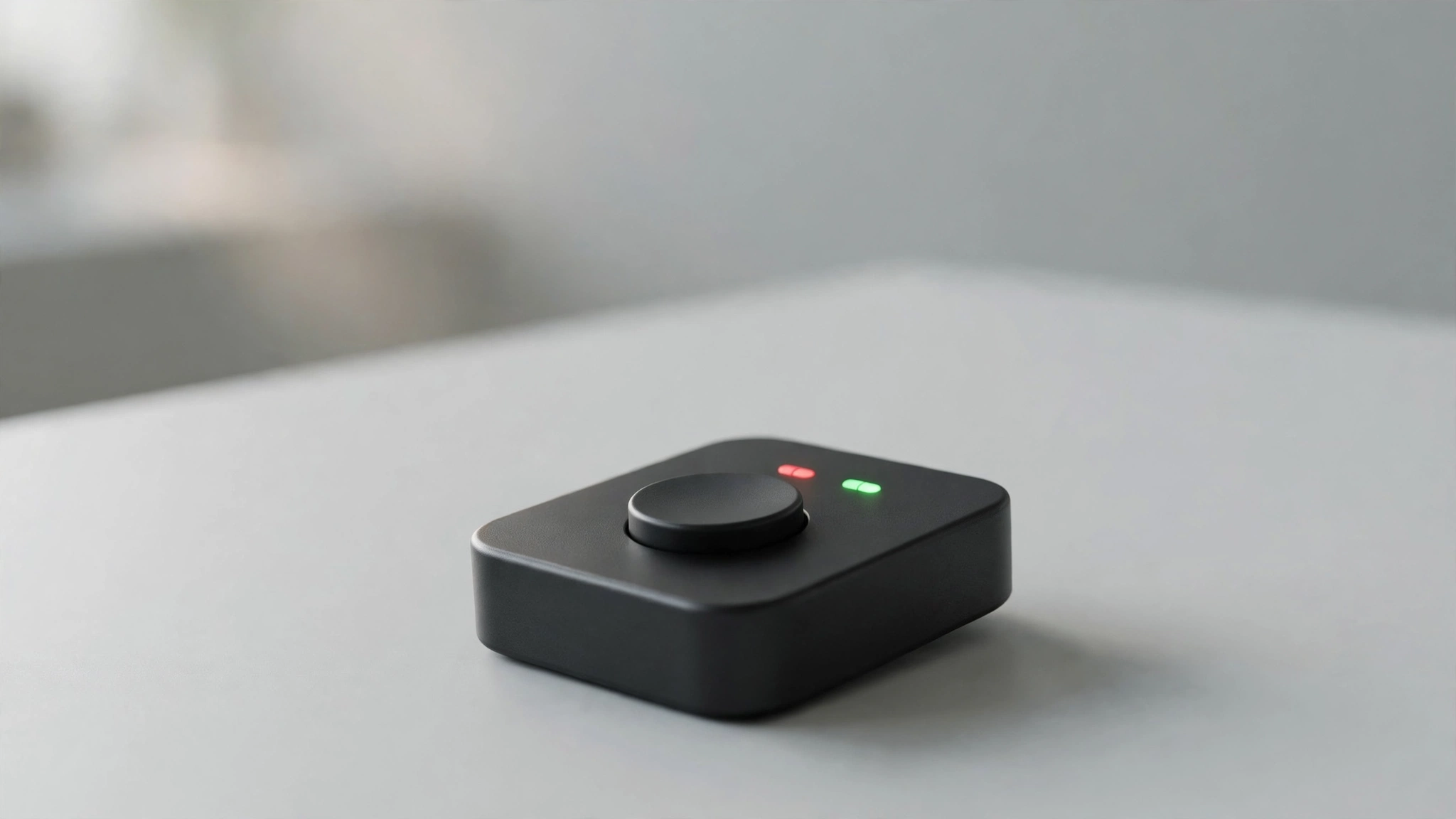
Nothing has spent a month telling us what its first AI device is not. It is not a phone. It is not a pin, a pendant, or a pair of glasses. It has no screen, and it could not have been an app. Now we know when we find out what it actually is: December 8, 2026. And thanks to a leaked photo posted by a DJ, we already have a good look at it.
The company announced the date on November 20 in an X post carrying the tagline “Be present. It’s noted.” — a line that, read alongside everything else Nothing has said, is the strongest hint yet about what this thing does. Chief executive Carl Pei has said the device will ship in December, so the gap between the unveiling and the first units reaching buyers should be short.
What Pei has actually said
The story starts with an essay Pei published on X on November 4, titled “Toolmakers.” In it he wrote, in full: “Our first AI-native product ships next month. It’s a tool, but one built with the personality and care that have come to define a Nothing product. It has no new screen, and it couldn’t have been an app.”
The essay’s argument is worth taking seriously, because it is the whole pitch. Pei’s claim is that AI’s biggest limitation is not intelligence but context: the models are capable, yet they know almost nothing about your day. Ideas mentioned over coffee, decisions made in passing, things said in a meeting and never written down — none of that reaches the assistant. A device that is present for those moments, he argues, closes that “context gap” in a way a chatbot never can.
He also drew a deliberate line under the category’s recent history. The race to build the “iPhone of AI” — wearable pins, pendants, smart glasses — is, in his telling, premature: transformative technology tends to find its footing in professional settings first, the way mobile phones did in the pager and car-phone era, before it goes mass-market. The value of AI today, he argues, concentrates in knowledge work: coding, IT infrastructure, legal, customer support. The device, accordingly, is framed as a productivity tool, not a consumer gadget for everyone.
Six days later, on November 10, Pei posted a nine-second video teaser captioned “Context doesn’t live in a chat box.” It stays tight on the front of the gadget: brushed metal, rounded corners, one very large button, two small glowing lights. Gadgets360’s description of the clip adds the details the video itself only hints at — a metal case with a textured body, two pill-shaped LEDs in red and green, and below them a white button carrying a red dot, apparently a physical trigger for recording.
The leak: a Talk button, no screen
Then, on November 19, the device showed up in the wild. Swedish House Mafia DJ Sebastian Ingrosso posted a photo to his Instagram story showing the gadget sitting on a desk between a MacBook and a pair of Nothing Headphone (1), and tagged Nothing’s official account. Tipster Yogesh Brar shared the image and confirmed through his own sources that it is the upcoming AI product.
What the photo shows, in the words of the outlets that have examined it: a palm-sized, slim, black rectangle with rounded corners and no display, roughly the size of two KitKat bars laid side by side — or, in Engadget’s less flattering phrasing, “two vapes stuck together.” Its most prominent feature is a large physical button labelled “Talk,” with a smaller button carrying a red record dot beside it. Above the buttons sit two pill-shaped LED status lights, one red and one green. There is a groove along the bottom that may be a pogo-pin connector for a charging dock or an accessory, and a small opening at the opposite end that could be a microphone. Both of those last two details are interpretations of a dim photo, not confirmed features.
One caution about the photo itself: Notebookcheck notes it may show two devices stacked together rather than a single unit with a seam down the middle, which would change how the enclosure should be read. Nothing has confirmed nothing about the image — no name, no price, no specifications, no battery size, no dimensions, no markets, no subscription. The company has not even said whether the device works on its own or needs a phone nearby.
The best guess, and why it is only a guess
Put the tagline, the buttons, and the lights together and most outlets land in the same place: an AI voice recorder, or a smart note-taker. The Talk button suggests you speak to it rather than tap at it; the record button and the status lights suggest it is listening and capturing; “Be present. It’s noted.” suggests the point is to be in the room and let the device take the notes. GSMArena, Gizmochina, 91mobiles, Notebookcheck, and Digital Trends all lean this way, with Digital Trends putting it plainly: “the red record button and the status lights make the recorder theory hard to ignore.”
The main alternative raised is a live translator, mentioned by several outlets as one of a few unconfirmed possibilities, never as the leading theory. One other claim deserves a flag rather than a repeat: Engadget, alone among the outlets in this research, suggests the teaser hints at “at least one camera, likely for some kind of visual intelligence feature.” No other outlet supports that reading, and Engadget itself calls it tentative. Treat it as speculation.
If the recorder theory is right, Nothing would not be entering an empty market. Plaud’s NotePin S, a $179 AI transcription wearable, is the product Digital Trends names as the obvious comparison, and Plaud says it has shipped more than a million units. Nothing already has a foothold in this territory, too: its Essential Space hub on the Phone (3a) series lets you press the Essential Key to capture a screenshot or record a voice memo that AI transcribes, then organises the captures into Smart Collections with summaries and action points. It is a reasonable inference that the new device plugs into that ecosystem — but no source confirms the link, so it stays an inference.
Why this one might not join the graveyard
The scepticism is earned. Dedicated AI hardware has a short, unhappy history. The Humane AI Pin was discontinued on February 28, 2025, its cloud service shut down, and HP bought the intellectual property for about $116 million; devices people had paid for stopped functioning as AI devices. The Rabbit R1, launched in January 2024 at $199 with roughly 100,000 units sold at launch, is still shipping and receiving updates, but it never delivered the agent vision it was sold on, and Wired has reported manufacturing has stopped.
What has replaced that first wave, according to an August analysis of the category, is narrower-purpose devices that no longer claim to replace your phone — Plaud’s transcription pin above all. That is exactly the lane Pei is describing: a narrow productivity tool with physical buttons instead of a screen or a voice-only interface, screenless by design, aimed at knowledge work first rather than at the mass-market “iPhone of AI” race.
There is also money behind the bet. 91mobiles reports Nothing raised $200 million in a Series C round in 2025 to build an AI-native platform combining hardware and software — a single-source figure, but consistent with a company that has been telegraphing this move for months.
None of that guarantees the device works, or that anyone wants it. A recorder that has to be carried, charged, and remembered is competing with the phone already in your pocket, which records perfectly well. Nothing’s answer, so far, is that the phone is the problem: it is a chat box, and context does not live in a chat box. On December 8, the company has to show what lives in its place.
Also today: GTA 6 made $3.79 billion on day one, officially — and the estimates were $1.4 billion low — and Claude-BugHunter, the #1 trending GitHub repo for hunting bugs with Claude Code.
Related: Google’s Gemini smart glasses are open for pre-order — Amazon’s Bee Frontier is a $75 AI wearable that listens all day — Claude Duet, Anthropic’s proactive AI agent, explained — GPT-6.2 Astra: 20% cheaper, and a safety first.
Leave a Reply