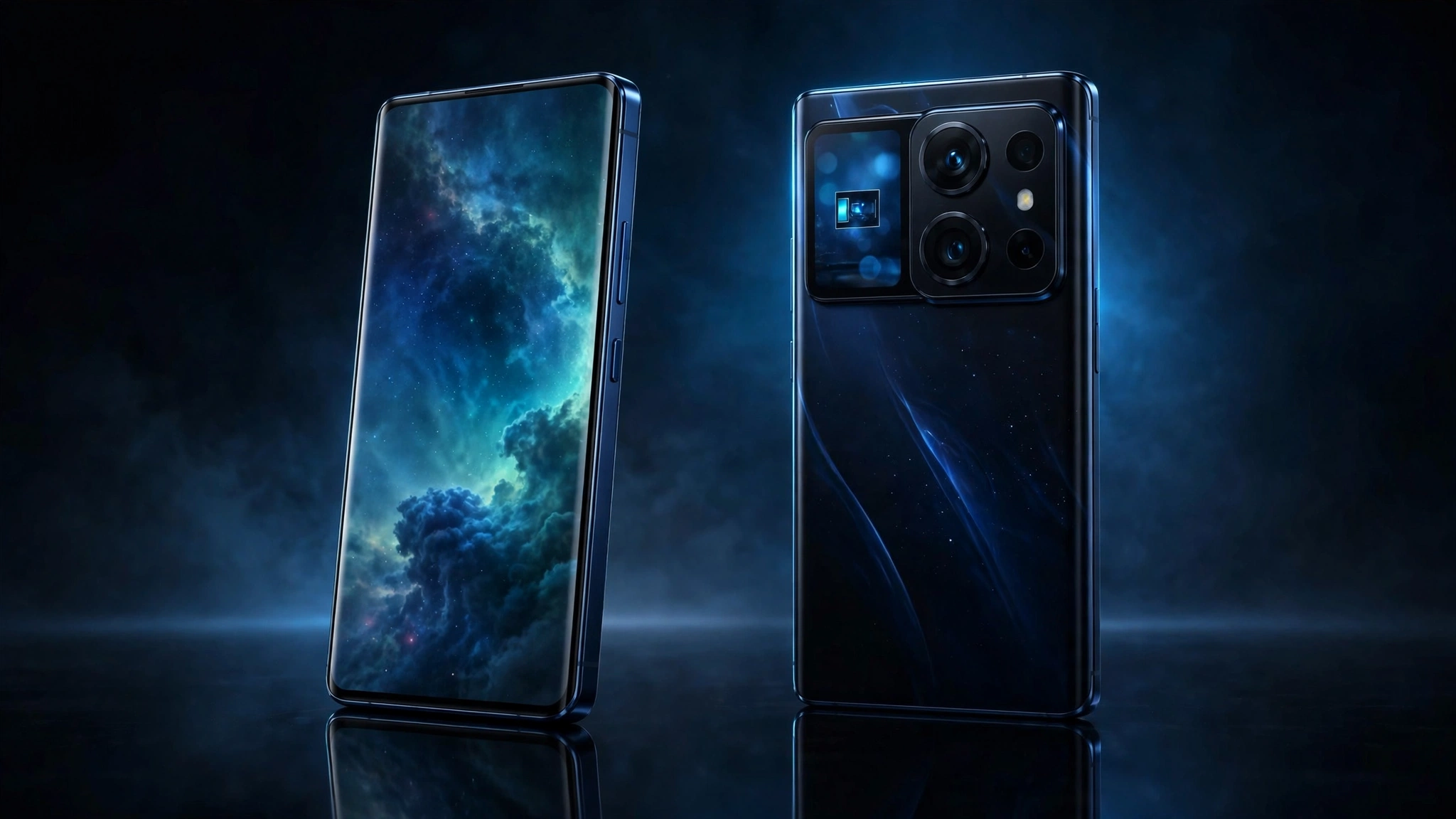
Xiaomi’s Pro phones have finally left China. On Monday, November 17, the company held a global launch event in Paris for the Xiaomi 18 Pro and 18 Pro Max — the first time a Xiaomi Pro series has gone on sale outside its home market. The phones that launched in China on September 23 are now on sale in the UK and parts of Western Europe, and they arrive with the most unusual feature on any flagship this year: a second screen on the back.
That is the headline. The fine print is where it gets interesting: the global phones cost far more than the Chinese ones, their batteries are smaller, and the early hands-on reports say the cameras — the other headline feature — still need tuning. Here is the full picture, including the parts Xiaomi would rather you didn’t notice.
The prices, and why they’re steep
The 18 Pro starts at €1,399 for 12GB of RAM and 256GB of storage, rising to €1,599 for 512GB. The 18 Pro Max starts at €1,599 for 12/256GB, €1,799 for 12/512GB, and a 16GB/1TB model is listed as “coming soon” at €2,099. In the UK the equivalent figures are £1,199 and £1,399 for the Pro, and £1,399 and £1,599 for the Pro Max.
Those numbers need context. In China the same phones start at CNY 5,999 (about $845) for the Pro and CNY 6,999 (about $1,040) for the Pro Max. The global versions cost roughly 65–70% more, and at €1,799 the Pro Max costs more than an iPhone 18 Pro Max or a Galaxy S26 Ultra in several European markets. Xiaomi used to be the company that undercut the big two; this launch puts it above them.
There is no US launch, and none is planned — DPReview, Engadget and PetaPixel all confirm the phones are not coming to North America. Importing is possible, and PetaPixel notes the phones are compatible with North American networks, but warranty and carrier-band caveats apply. The 18 Pro is confirmed for India, with no date or price yet, and the Pro Max has not been confirmed for India at all. Sales began on launch day in Germany, France, Spain and the UK through Xiaomi’s own store and, in the UK, Amazon — although GSMArena’s launch-day story said sale dates were yet to be announced, so Xiaomi never gave one single global sale date.
The second screen is the whole phone
Both phones have an AMOLED display on the back, next to the cameras: 2.7 inches on the 18 Pro, 2.9 inches on the Pro Max, both 120Hz with up to 4,000 nits of peak brightness. It is the feature every hands-on reviewer spent the most time on, and the consensus is that it is genuinely useful rather than a gimmick.
Its main job is as a viewfinder: frame a selfie or a group shot with the 200MP rear cameras instead of the weaker front camera, with a palm gesture to fire the shutter, and the phone switches to the ultrawide automatically when it detects three or more people. Beyond the camera it handles notifications, calls and live activities like navigation and food delivery, pins boarding passes and QR codes, and controls Spotify, YouTube Music and Google Maps. The most interesting trick is AI Interpreter, which translates a face-to-face conversation in 29 languages with each person seeing their own language on their own side of the phone. There is also a GenAI Apps feature that builds small mini-apps for the rear screen from a natural-language description, with more than 50 presets including timers, score counters and dice.
But the rear screen has limits that matter, and two outlets confirmed them independently. The rear-screen camera interface works with the 1x main camera and the 0.7x ultrawide only — not the dedicated telephoto. Pinch-zooming to 3.2x on the back screen is a digital crop, not the telephoto module. Only Photo, Video, Portrait and Photo Booth modes are available on the rear screen, with no Leica filters, and DPReview noted there is no alert when something on the front screen is blocking a capture — you have to flip the phone over to find out why. Xiaomi also claims Gemini Live works on the rear display; Engadget could not get it to work.
Two 200MP cameras, one honest caveat
Both phones carry the same three Leica-branded rear cameras: a 200MP main (f/1.67, optical image stabilisation, 23mm equivalent), a 200MP periscope telephoto with 3.2x optical zoom, and a 50MP ultrawide. The one sensor difference is the main camera: the Pro uses Xiaomi’s Light Fusion 960, while the Pro Max gets the Light Fusion 960L with a LOFIC design that Xiaomi claims delivers 16.2 stops of dynamic range. That figure is the company’s own claim — no independent test exists yet, and it should be read as marketing until one does.
The early hands-on reports are encouraging on the camera controls and cautious on the results. DPReview, working from the Paris event, called the rear display and the extensive rendering controls — Leica Vibrant and Authentic styles, a Palette tool, film looks like B&W Film and Iconic CCD — “the most appealing parts” of the phone, but found the main camera “tended toward overly bright exposures,” slow to adjust exposure when reframing, and night HDR “overprocessed, somewhat old-school HDR look.” Engadget, after a few days with the Pro, said the cameras “don’t seem to reach the dizzying heights of last year’s 17 Ultra,” with the Pro “often struggl[ing] to capture moving subjects and low-light scenes,” though daylight and macro shots were crisp. PetaPixel flagged the narrow 102° ultrawide and the absence of a 24fps video option. None of these are final reviews — several outlets had already published fuller tests by November 22 — but the pattern across the early coverage is consistent: deep camera controls, unfinished tuning.
The battery nobody asked about
Here is the quiet downgrade. The global 18 Pro has a 6,000mAh battery; the global Pro Max has 7,050mAh. In China the same phones ship with 7,000mAh and 8,500mAh cells. That is 14% and 17% less capacity, and Xiaomi has not explained why. One AI roundup has already misattributed the 8,500mAh figure to the global Pro Max; the 7,050mAh figure is confirmed by GSMArena’s spec page, PetaPixel, Engadget and Notebookcheck.
It is worth keeping in perspective: 6,000 and 7,050mAh are still larger than most European flagships, and charging is fast — 90W wired on the Pro, 100W on the Pro Max, 50W wireless on both, with 27W reverse charging. But the battery was one of the two reasons to be excited about these phones in China, and buyers outside China are getting a smaller version of it at a higher price. That trade-off deserves to be in any buying decision.
The rest of the spec sheet
Under the hood, the Pro runs Qualcomm’s Snapdragon 8 Elite Gen 6 and the Pro Max the Extreme version, both 2nm chips with prime cores up to 5.01GHz. The main displays are 6.4-inch and 6.9-inch LTPO AMOLED panels at 1–120Hz with 4,000-nit peak brightness, and both phones run Android 17 with HyperOS 4 out of the box, with five major OS updates and six years of security updates promised until November 2032.
There is also a hardware-level Privacy Display on the main screen — dedicated narrow-angle privacy pixels with per-app toggles and gaze-detection alerts. It is a real idea, but both Notebookcheck and Tech Advisor found it noticeably weaker than Samsung’s Galaxy S26 Ultra implementation, visible at angles rather than just extreme ones. Other details: an ultrasonic in-display fingerprint sensor, IR blaster, Wi-Fi 7, Bluetooth 6.0, an AI Button that Tech Advisor and Engadget both found under-customisable (five functions, short press for AI Translate Conversation, long press for AI Voice Note), and IP68 water resistance globally — Xiaomi’s spec sheet also lists IP66/IP69, so check the regional listing before relying on the higher rating.
Who should buy one — and who shouldn’t
The 18 Pro and Pro Max are for a specific buyer: someone who wants the most capable camera phone Xiaomi has ever sold outside China, values the rear screen as a creator tool, and lives in a market where the phones are actually sold. The rear display is the real differentiator — nothing else at this price does face-to-face translation and rear-camera selfies this way — and the camera controls are the deepest on any Android phone this year.
Everyone else should pause. If you are in the US, there is no official route. If you shoot a lot of moving subjects or low light, the early camera tuning is a genuine concern and the first software updates will matter more than the launch-day spec sheet. And if the battery was your reason to look at these phones, remember the global models are smaller than the Chinese ones — while costing roughly two-thirds more. The phones are impressive and overpriced in the same breath, and that tension is the story of this launch.
Also today: GTA 6 players on Xbox are getting two-day bans for clips the console uploads by itself — here is the one setting to change, and CLI-Anything, the free tool turning Blender, GIMP and 80+ other apps into things your AI agent can drive.
Related: the Motorola Signature 27 at $1,599, the OnePlus Ace 7 Pro with its built-in cooling fan, the Honor WIN 2 gaming phone with two physical fans, and the Redmi K100 and its 10,000mAh battery.
Leave a Reply